 “In fact, I don’t think it represents the interests of anyone, unless they look like the vast bulk of the membership, which were either housed agents, who received commissions, or charged asset fees.
“Asset fees was a particular bugbear for me, because I was there when they were born. Back in the mid-90s, when commissions were on the nose, that’s when they were born. And the conversation went something like this; the internal thinking among the financial planners concerned at the time was something like this: ‘We can’t call these things commissions anymore, we can’t receive commissions anymore, so how can we get paid the same way – not lose any revenue and keep the upside the same, all of the blue sky – and not call it commissions?’
“ ‘I know – we’ll call it a fee for service, because it’s not being paid by the product providers anymore now, it’s being paid by the client, out of the product.’
“It’s just that you can’t call a wrap a ‘product’; it’s not a financial product. It’s a service. It’s a loophole that you can drive a truck through. So they came up with the asset fee. And the reason it’s a conflict – it doesn’t mean it’s a bad thing, it’s just that it’s an incentive, and that’s the territory of a salesperson. You incentivise your salesmen. If you want to distribute a product, you incentivise them.
“If I’m a client, and you’re being paid on a figure that’s going to be dependent on what the outcome is, that’s an incentive. Again, it’s not a dirty word; I was a salesman for a long time. It’s not a dirty word at all. But the issue is, it’s not an adviser’s role. If you’re going to get an adviser, get an impartial one. What’s the point of having an adviser who’s not impartial?
‘A series of half-wits, one after the other, got up and criticised him for shelf space fees’
“And the legislation is clear: You cannot call yourself independent or impartial if you do not satisfy 923A. So I thought, well, look, the FPA doesn’t represent the particular needs that I have got, and not the needs that I believe the clients should want. And disclosure and all that, you know, it’s OK to have conflicts; just disclose them, yeah, but we’ve still got Opes [Primes] and Basis Capitals and Westpoints and god knows what else – how many pages now are FSGs?”
Brammall says the Association of Financial Advisers “basically hadn’t changed” since he was a member, back when he worked in insurance – so that would not be the association to represent independents, either.
It did occur to Brammall around this time that everyone else was wrong except him. But inspiration arrived from an unexpected source: Roger Corbett, the former chief of the supermarket group Woolworths, appeared at the FPA conference. And at the end of his formal presentation, Corbett took the opportunity to express his views about the state of financial planning. While one might expect the audience to sit up and take notice – which planner, after all, would not covet Corbett as a client? – the response he got was quite unexpected, and quite hostile.
Corbett identified two significant issues in the industry, and the first was conflicts of interest. The second was that when a client entrusts their life savings to a financial planner, it’s a one-shot deal: they do not have another lifetime to accumulate more savings if the advice is poor. They need and deserve advice of the highest quality. The industry would have to raise the bar considerably to win the trust of Corbett and people like him.
“A series of half-wits, one after the other, got up and criticised him for the shelf fees that Woolies charges its product suppliers – that’s a conflict of interest that’s not disclosed, and blah, blah, blah, blah, blah. So everyone missed the point,” Brammall says.
“They missed the point. You do not go to Woolies for financial advice – at least not yet. They were still caught in the sales and distribution channel thing. You’ve got to build a business, and stuff. A client you would love to have tells you what you need to do to win his trust, and his money, and you’re calling him an idiot.”
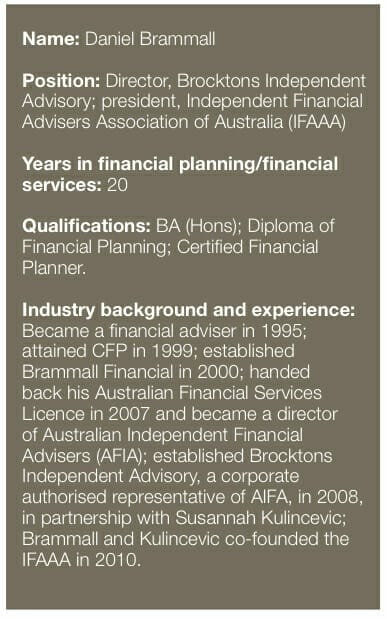
Brammall handed back his licence, and quit the FPA, handing back his CFP designation as part of that. And he joined Australian Independent Financial Advisers (AIFA) as an authorised representative.
Around the same time Brammall was setting up his current business, Brocktons Independent Advisory – named after a restaurant in San Diego, where Brammall was dining when he was casting around for a good name – the idea for the IFAAA was also born.
AIFA, run by Travis Morien, in Perth, had the same vision of independence.
Starting a new business, with a clean sheet of paper, was a difficult decision.
“That hurt,” Brammall says. Having an existing book of business would have been an easier problem to deal with.
“If you have 100 per cent of your clientele paying you a conflicted remuneration package, then the only thing that’s between that and having an unconflicted proposition is basically a mindset,” he says.
“Go and talk to each of the clients and have them sign up for the service package that you now offer, for a set fee. It can be an hourly rate; it can be a flat fee; it can be a monthly retainer. There’s lots of different ways.