


HOYLE: Well, we’ve got Richard, John and Dante here representing three key bodies. What work are you guys doing, what work could you guys put your heads together and do on this “Plan B”?
BROGDEN: Well, internally we’re doing some work on a mirror image of the member’s super chart. We’re looking at a member life charter with respect to remuneration. So we’ve been working on that. I’ve been there 12, 14 months; we’ve been working on it from day one.
BROWNE: I’m involved in that committee, and by creating that forum I’m actually seeing a convergence of views. So maybe the initial starting point was a large number of significantly different views. Creating that forum has allowed the different stakeholders within the industry to sit down and work through the details, and I can see that that is leading to what will be a consensus point of view from a representative group from right across the industry: bank-owned, non-bank owned insurers. I think it’s a really very positive step.
BROGDEN: The interesting thing is we’re framing this whole debate in the rest of FoFA which is the abolition of commissions on superannuation – so, black to white. I guess what the industry is saying is you can’t go from black to white, or white to black. There’s just no ability to do that. There has to be a middle ground, if there is to be change. And I think the question is, do we promote a mid-ground or do we respond to a call for change?
“And the fascinating thing is, I don’t think there’s a public uprising about commissions”
BROWNE: But as far as the industry framing the argument, you can’t do it. Well, clearly the government has the authority to be able to do it. Where I think we need to frame our argument is the consequence of doing that, not only for us as an industry, and I grant that for some sections of the industry banning commissions would be catastrophic. It wouldn’t be bad, it would be catastrophic.
My concern is the consequence of that for the Australian consumer would be absolutely devastating. A very significant number of Australians would be left in precarious positions that would ultimately lead to them encountering a terrible financial position at the same time that they had a horrific disablement or death in the family.
And that’s why the industry is focused on this issue. We understand that there are implications for us as an industry but we need to elevate the argument to make sure that our concerns are concerns that go hand in glove with Australian society.
I think about the work that we’ve done over the last 20 years. The work that we’ve done that we can take the greatest pride is the work that we’ve done on behalf of the clients. I believe that the true heritage of our industry is that heritage that hasn’t come from mergers and acquisitions, that hasn’t come from takeovers, it hasn’t come from product development.
The true heritage of our industry is in the event that a tragic event occurs in the lives of our clients, we as an industry have been able to step in and provide some sort of solace. And our key challenge but also opportunity is to collate and communicate those stories in a rational, powerful and convincing way.
KLIPIN: I think there’s greater strength in let’s get our act together collectively rather than let’s try and play each other off and see who’s going to come out on the top of the pile.
SATILL: Just one other point, and I know in the scheme of things it’s small, but it’s close to my heart. Because we have a unique practice in Australia which I mentioned places cover on impaired life. So that’s the three or four per cent of Australians who actually can’t get cover, get declined by the insurance companies. You know, those with mental history, diabetics, heart disease, cancers and et cetera.
That’s our area of expertise. Now, the amount of work that we’ve put into that, there is no way that 80 per cent of them could afford to pay us for what we do if there were no commission.
BROGDEN: And the fascinating thing is, I don’t think there’s a public uprising about commissions.
And it’s hard to pinpoint systematic failures in the industry, although I’d agree with the possible ‑ with the exception of churning.
What concerns me about churning is it drives up cost.
SATILL: And that adviser’s not a professional. Doing it for the wrong reasons.
BROGDEN: Yeah. But it just makes it more expensive. Like any product, the more affordable, the bigger the take up, the better the outcome. Everybody wins, the more insurance we sell. Everybody wins.
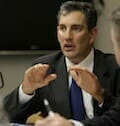
KLIPIN: The way we manage the message becomes important because yes, there is some churning and yes, there are some large cases that I’ve heard gets the average person’s income twice in one hit, but they are few and far between, and I’d rather – if we’re going to allocate resources, spend time and energy – focus on how to we lift penetration of insurance…rather than going after the so-called bad guys.
HOYLE: This has kind of brought us back to almost where we came in, just about why it is absolutely critical that the provision of risk plays hand in hand with good advice. We’re getting close to time so I just wondered whether we might run around the table quickly, just asking you just off the top of your head: Is the future for risk advisers rosy? Are the issues that we’ve discussed today, do you think, bumps along the road? Or do they represent a genuine threat to the livelihood of risk advisers?
COOK: I think Richard said earlier that the low percentages of Australians that are anywhere near properly insured, so I think the future for risk advisers is rosy enough. I mean exactly how it’s delivered, we’ll see how that pans out. But I mean, we’re talking about what is the right level of cover. I mean you could hire a couple of actuaries and they’ll come out with different opinions but you’d be able to average them or whatever.














More expensive…..God give me a break!! Strip out the commission a client pays over a life time vs. a one-off flat fee to get the cover in place, review it 3 or 4 times across a persons life time and then tell me which is more expensive. And we are not talking a small difference here boys.
Do you mean to tell me that as an industry we can’t propose a number of intelligent alternative methods of payment for debate that adequately compensates for the time to get the cover in place + a profit. And while not my preference, but just to meet the needs of advisers, surely we can structure payment via the product, but the difference being that it stops and therefore reduces the overall cost to the consumer. Or are we are all just a bunch of morons?….don’t answer that!!
“Oh but we do so much at the time of claim and do all this hand holding stuff which justifies what we get paid”. Lets not even go there. Or how do “we charge if a claim is made”. Have a bit a faith in yourself and send them an invoice. After all you’ve delivered so much value, right!!
Or “how do we get paid if the client gets knocked back?” Review your process, ask more medical questions before you get them to fill out an application so if need be you can chat to an underwriter, and then if you still get stuck, charge them. Go on I dare you to try it.
As for a round table, it’s pointless only including those that support maintaining the status quo. Where is a voice for the consumer, you know the one that pays 1 out of every 3 premiums to support the existing remuneration system? No, don’t worry about them, their our meal ticket but in the same breath we’ll couch everything in terms of “looking after our clients and how wonderful they think we all are and how the sky will fall on heads if we change anything”.
Face it, the current system has delivered the under insurance problem and sticking with it ain’t going fix it. If we are fair dinkum about it, the system needs an overhaul and I’m not just talking about remuneration. Otherwise ,industry reps mouthing words about underinsurance are nothing more than hollow, thoughtless statements.
Bowen’s April FoFA statement was like reading an insurance industry press release on underinsurance. Well done chaps, good lobbying. Change? We’ll have none of that thanks!!
I don’t doubt there are certain issues that require more consultation and thought but stop acting like the hunted and start acting like we have a brain.
Please dont put risk advisers in the same bucket as Lawyers where the general concencus is that you are only interested in billable hrs
Echoing Richard Klipin’s remarks, banning commissions would be LOSE, LOSE, LOSE in terms of each stakeholder (consumer, taxpayer, product manufacturer, adviser, families of would-be claimants and even the government). It is as illconceived a concept as it is dangerous.
At last some common sense, hopefully the government will listen