Darroch says: “If on the ASX the price gets away from fair value, the players look at that and go and create baskets [of the underlying stocks] at a lower price, and sell them to people at a higher price.”
“This arbitrage…forces the price on the secondary market back to fair value,” she says.
“That mechanism allows investors to know that the price they’re paying in the secondary market is always fair.”
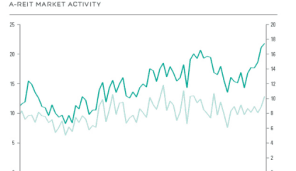
The ASX says that at the end of June, 2009, the value of all ETFs listed on the market was about $1.86 billion. There was an average of about 600 ETF trades a day – a low figure compared to, for example, A-REITs, in which there were almost 34,000 trades a day. But as Darroch, Laidlaw and Fuhr agree, we’re on the cusp of significant growth in the Australian ETF market, and those figures need to be compared to earlier dates to gain an appreciation of how far the sector has come. In June 2008, for example, the ASX said the value of Australian ETFs was $1.77 billion, and there were 368 trades a day.
And in June 2007, the value of ETFs was $1.15 billion, and there were just 123 trades a day. When Fuhr started working in the ETF field in 1997, there were 21 products globally, worth $8 billion. Until June 2008, Fuhr headed Morgan Stanley’s award-winning ETF research team, but as part of a cost-cutting initiative, that team was disbanded. By September the same year, Fuhr had resurfaced at BGI. Morgan Stanley’s timing was poor – in the 12 months ended June 20, 2009, during one of the most severe global economic slowdowns in history, the value of the global ETF market increased by $US80 billion. Clearly, despite global economic conditions, investors and their advisers around the world have continued to favour ETFs as an investment vehicle.
The take-up of ETFs in countries where the products have previously have been rolled out has been “quite similar to what you’re seeing in Australia”, Fuhr says. Generally, there’s an initial period when the products are available, but remain largely overlooked. However, once the benefits and potential uses of the products are understood and sink in a bit with planners and investors, there’s a relatively rapid acceptance; money starts to flow to the funds, and then there is an influx of new products and issuers. Fuhr says one of the key attractions for investors is that ETFs are exceptionally low cost, even by index fund standards.
“Retail investors get the same economies of scale that hedge funds and large pension fund players get using ETFs, even when they [large investors] are putting in $1 billion or a couple of hundred million dollars,” Fuhr says.
“You can come along and put in a couple of hundred thousand, or whatever, and get the same cost benefit.”
Fuhr says growing numbers of financial planners are embracing the idea of ETFs as they come to recognise that what clients are willing to pay for is not necessarily picking the next hot fund or fund manager, but getting strategic asset allocation right and using the most cost- and tax-effective structures for implementation.
“You’re seeing this movement towards being paid for advice,” Fuhr says.
“That goes along with the old [Gary] Brinson study where he looked at what drives performance and found that getting your asset allocation right is the key to driving performance.
“I have always positioned ETFs as being a tool to enable planners to do their jobs. Over the years, you’ve seen that story being embraced.
If you look globally…you will see that many of the private banks have also embraced using ETFs, because they see that where they can add value is in advising clients as to where they should be investing.
“[And] if you look at the use of ETFs by fundsof- funds [FoFs], where their job has been to pick good active managers to do fund-of-fund strategies, I would say that over the past two years we’ve seen a significant uptake in the use of ETFs.
“It’s hard to find good active managers, but they’re also seeing increasingly that where they can add value is getting the asset allocation right.”
Fuhr says regulatory change has also underpinned this take-up. In Europe, for example, while UCITS III still limits how much one fund may invest into another, the limit has been raised fourfold. Fuhr says that in addition to low costs and efficient diversification, retail investors also enjoy other benefits by using ETFs to implement an investment strategy.
“With an ETF you can see what is inside of it; you can see what are the fees; you can see, in real time, the price – one of the appealing features is you can see them trading on an exchange,” she says.
“You have the ability to trade with multiple brokers. And you can trade at any time during the day.”
ETFs launched in Australia so far are exclusively long-only, index-tracking funds. But that may change in coming years as new issuers move into the domestic market. Overseas there are actively-managed ETFs, and in mid-July, ProShares launched the world’s first 130/30 ETF – a fund that incorporates both leverage and short-selling. Darroch says demand from local investors will drive the development of the Australian ETF market.
“I can see new products coming out,” she says.
“I think that if demand is there, then new ETFs will be created.”