

Self-managed super funds (SMSFs) – and many other vehicles that planners often work with, such as family trusts or unit trusts – are typically established and have their terms varied by way of deed.
Naturally, proper execution of a deed is critical. Accordingly, I thought I would focus on how a deed should be executed, as it can be critical that each deed is correctly executed.
If a deed is not correctly executed, whatever action it is trying to implement (eg. the variation of an existing deed) may well fail.
Remember that there are general law rules that only a deed can vary another deed. See for example the discussion at paragraphs 72–4 of ING Funds Management Ltd v ANZ Nominees Ltd [2009] NSWSC 243.
Requirements for individuals
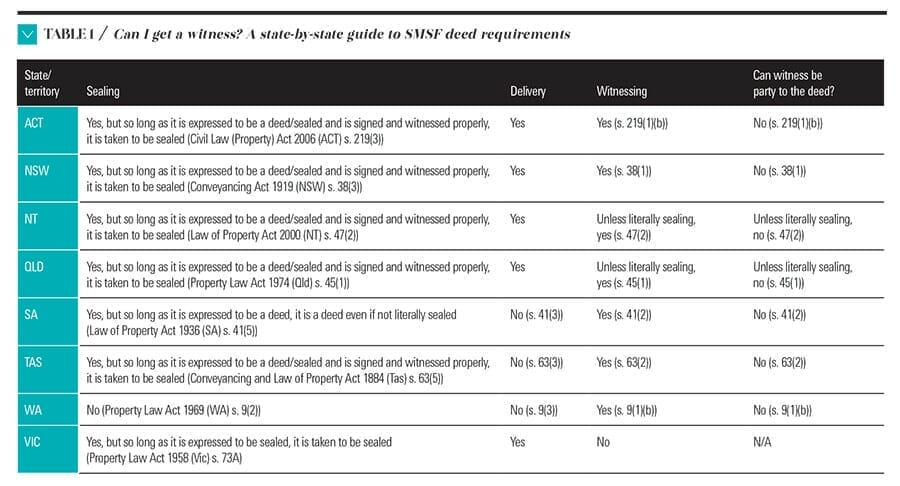
Each jurisdiction has slightly different requirements as to how a deed should be executed by an individual.
For example, in New South Wales an independent witness is required for valid execution. See s. 38(1) of the Conveyancing Act 1919 (NSW). However, in Victoria there is no equivalent requirement.
Because one never knows in which jurisdiction a deed might be litigated, all individuals who sign deeds should have an independent witness. Nevertheless, I now summarise the position in each Australian jurisdiction:
Requirements for companies
Execution of deeds by companies have their own rules. Section 127(1) of the Corporations Act 2001 (Cwlth) provides:
“Execution of documents (including deeds) by the company itself
A company may execute a document without using a common seal if the document is signed by:
(a) 2 directors of the company; or
(b) a director and a company secretary of the company; or
(c) for a proprietary company that has a sole director who is also the sole company secretary – that director.”
The Corporations Act 2001 (Cwlth) is silent as to how a sole director company with no secretary may execute a deed. In such circumstances, it is the constitution of the company that must be looked to. Most constitutions are also silent on this point. DBA Lawyers’ company constitution is one of the few that covers this. It provides that:
“The Company may execute a document with or without using a common seal if the document is signed by: … where the Company has one Director – that Director, regardless of whether or not that Director is a secretary of the Company.”
However, many financial institutions will only recognise a sole director company as having validly executed a deed if either that director is also a secretary, or another person who is a secretary has also signed.
Accordingly, even if a company has a DBA Lawyers’ constitution, it is still typically best practice if all directors are also secretaries. This will ensure that documents are processed with minimal fuss by financial and other institutions.