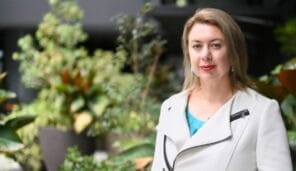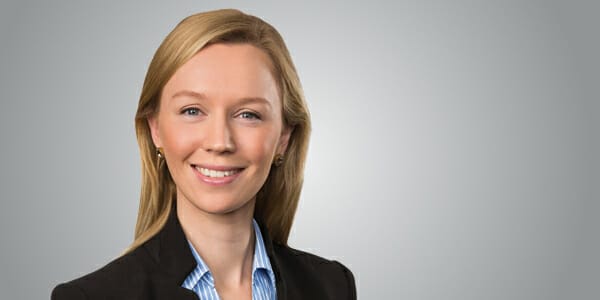

In the second part of a series on notable CFPs, Crowe Horwath associate adviser Amy Early discusses the role that higher educational standards play in the development of a professional career.
After Amy Early finished university in 2007, where she studied economics and politics, she emerged with no specific professional direction in mind. Financial planning certainly wasn’t a first-choice career.
“I didn’t really understand what financial planners did, because I’d never been to see one myself,” Early says.
“My first instinct was to think of someone in a bank, just giving basic budgeting advice, maybe some investments; I really didn’t consider the broad range of topics that financial planners would give advice on. I hadn’t considered Centrelink, salary packaging – all those topics that most people don’t think about when they think of financial planning.
“But when I started learning all of that stuff, I thought was something that would really interest me because you had such a broad range: estate planning; things that are very useful, but very diverse.”
Fast-forward to December 2014, and Early was named as the second winner of the Gwen Fletcher Memorial Award for the top-performing candidate in her Certified Financial Planner (CFP) studies. From knowing nothing about financial planning, Early now numbers herself among the estimated 5700 individuals in Australia to hold an internationally recognised financial planning designation.
Absolute shock
Early says she responded to the award with “absolute shock”. She started the CFP program after completing a Graduate Diploma in Financial Planning, so she was exempted from three units of the CFP program.
“It is really difficult,” she says.
“The assignment is a lot of work, it takes a lot of time; but the exam I found quite difficult because I hadn’t done CFP 2, 3 and 4. It was all self-guided study; I just had to work out what I had to study and study as hard as I could.
“It’s a three-hour exam and it’s multiple choice, but the questions are quite tricky. At the end of the exam I was quite miserable. I’d wanted to smash it, and I thought I hadn’t smashed it, I’d barely scraped through. So I was shocked.”
Early says she worked hard at university, “but I didn’t ever really have to work that hard to get through”.
“But with the CFP, you have to work really hard just to get through,” she says.
“There are definite challenges doing the study and working at the same time. At uni, most of the time I had too much time on my hands.
“I found the time management [of CFP study] OK; I could handle that – I just had to give up my social life for a year. It was more the standard of the work you’re doing and the breadth of topics you’re covering is a lot to take in. It’s self-guided so you’re never quite sure what they’re going to ask you in the exam, because they can’t possibly ask you everything.
“We have paid study leave [at Crowe Horwath], and because my managers and a lot of the people I work with have done the CFP they are very understanding of the commitment it takes. I was pretty lucky – I got a lot of support through it.”
Two-year break
Early started her career at Prescott Securities, in the firm’s Sydney office (which is now closed)*. After three years at Prescott, Early had a two-year break living in Germany, where she undertook a teaching course and taught English to German students.
On return to Australia there was a position going at Crowe Horwath which she took and where she remains today as an associate financial planner. She joined the firm as a client service manager.
“I guess that’s the equivalent of a junior financial planer,” Early says.
“You work with a financial planner on set clients; you kind of managed the behind-the-scenes process. You go to meetings, you look after the implementation of advice, sit with the adviser on the strategy development. It’s really a support role, getting you ready to be an adviser. You see how it works and you get involved in all of the processes. You become familiar with the clients; they become familiar with you.”
Professional foundation
Early says that continuing study after university and obtaining a recognised profession-based designation gives here a better professional foundation.
“It was really always important to me not to just jump in to being an adviser before I knew what I was doing,” she says.
“I was just so conscious of the responsibility you have when you’re looking after clients’ financial affairs. I was really keen to know I had the right qualifications, and enough qualifications, to do it well. I don’t like to do a job badly. I like to do it well.
“The natural step from doing the CFP is you keep moving forward, taking on more responsibility, taking on clients of your own, getting out there and meeting new clients, bringing clients into the business. I saw that as a natural progression from the CFP. You get more knowledge, you become more recognised as an adviser.”
From a starting point of not even considering financial planning as a career, Early says she uncovered for herself most of the information she needed about pathways into financial planning.
“A couple of times, financial planning came up as something I might like,” she says.
“I did a little bit of research into it and what was involved, because I didn’t have a finance degree, but from what I studied I could see that I could do the graduate diploma, and then the CFP.
“It was a little bit daunting, because I’d just finished five years of uni and I didn’t want to have to do another five years of study.
“But when I came back [from Germany] I was really focused and ready to start the CFP.”
Recommended career
Early says she would recommend financial planning as a career even though it is “a bit underestimated by the general public just how rewarding it is for a financial planner to help people”.
“A lot of people focus on the product selling side of it because that’s what you see in the news, especially with the scandals with the big banks at the moment,” she says.
“So I do think a lot of people don’t recognise that as financial planners we help people; and for a lot of us, that’s what we do it.”
“In a way it’s a little bit like being a teacher. You explain things to people, you help them understand where they are financial or how you’re going to do something; implement a strategy; and through explaining that and helping them understand, they feel a lot more at ease. It takes away a lot of stress.”
* This article was edited on March 23, 2015, to clarify that only the Sydney office of Prescott Securities closed. The firm has offices in Melbourne, Adelaide and the Gold Coast. Prescott Securities is a wholly owned subsidiary of Crowe Horwath.