
Scaled financial advice delivered through technology-mediated channels will underpin State Super Financial Services’ (SSFS) approach in the near future, according to the head of the public sector dealer group.
With around 160 financial planners, a number that has been steadily growing, SSFS provides financial advice to members of the Australian public sector – a potential pool of more than 250,000 people.
While its clients comprise a relatively senior demographic, the group is employing innovative advice delivery methods to service this member base and to also grow its appeal to a younger audience.
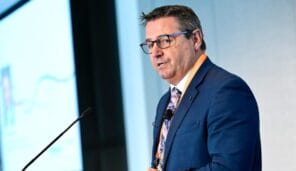
Speaking on the sidelines of the Professional Planner Dealer Group Summit this week, Michael Monaghan, managing director of State Super Financial Services, believes cloud-based and digital technology can lead to substantial efficiency improvements.
He says the business is now “four or five months and several million dollars of expenditure further on” in rolling out what he calls its Future Operating Model.
“In a simplistic sense, we’re replacing our advice system and our customer relationship management (CRM), as the first step toward making it completely digital and cloud-based,” Monaghan says.
“The basic principle is that clients should be able to interact with us in any way they choose, so I can see our relationship with our clients in the future encompassing both face-to-face as well as over the phone, web chat, self-service – any way the clients are happy to choose, and in fact probably using all of those methods in communicating with us.”
Front and back
Along with revamping the client-facing part of the financial planning business, the large-scale project also involves overhauling its back-office functions, including processing and record keeping.
As part of this, internet-based communication tools such as Skype will play a significantly larger role in how SSFS delivers advice to its clients as this program rolls out.
Monaghan concedes this is not without its challenges, including overcoming resistance among some of its more technology-averse clients, particularly given the large ‘baby boomer’ demographic among State Super’s member base.
However, he believes the widely held belief that such communication methods only hold significant appeal for generations X and Y is a misconception.
“In fact, the biggest take up of mobile devices like tablets and so forth is in the baby boomer generation, that’s around the world and here in Australia. I think all of our demographic, including the older people who are retired, are very interested in technology and want to have access to online and web-based services,” Monaghan says.
“People say to me, ‘Well, do you think that clients will use it?’ but I think Skype is very straightforward.”
Monaghan refers to the widespread use of this and other voice-over-internet protocol (VOIP) technologies by its clients, for example, in staying connected with children and grandchildren that may be overseas or interstate.
While no specific targets have been set out at this stage, he says they know the areas in which they expect to see productivity benefits.
“At the moment, when we’re talking to someone who’s thinking about retiring, we might see them three or four times before they retire,” he says.
“We can still see them three or four times, but maybe it’s a self-service experience or an over the phone experience. That saves the clients a lot of time but it also improves our productivity quite a bit.”
The scale dilemma
Given the mid-sized scale of SSFS, “one of the key issues for financial planners, both individually and for us as a medium-sized dealer group, is the productivity of the planners”, Monaghan says.
One of the ways Monaghan says he hopes to boost this through technology is by enabling “better triage of our clients, so rather than sitting down with one of our planners for a scaled advice piece, they can do it over the phone or self-serve, which saves a lot of time”.
While still in currently in development stage, SSFS expects to bring some of this technology to market towards the end of 2014.
“Then another big chunk of that project will be the back office systems,” he says.