
Australia’s super system is confronting three intertwined investment challenges tied to the Your Future Your Super performance test, according to Geoff Warren, research fellow at The Conexus Institute*.
Criticism around the current iteration of the performance test is well-documented, with many warning that it encourages “benchmark-hugging” behaviours, fails to account for responsible investing and places too much weight on fees rather than long-term returns.
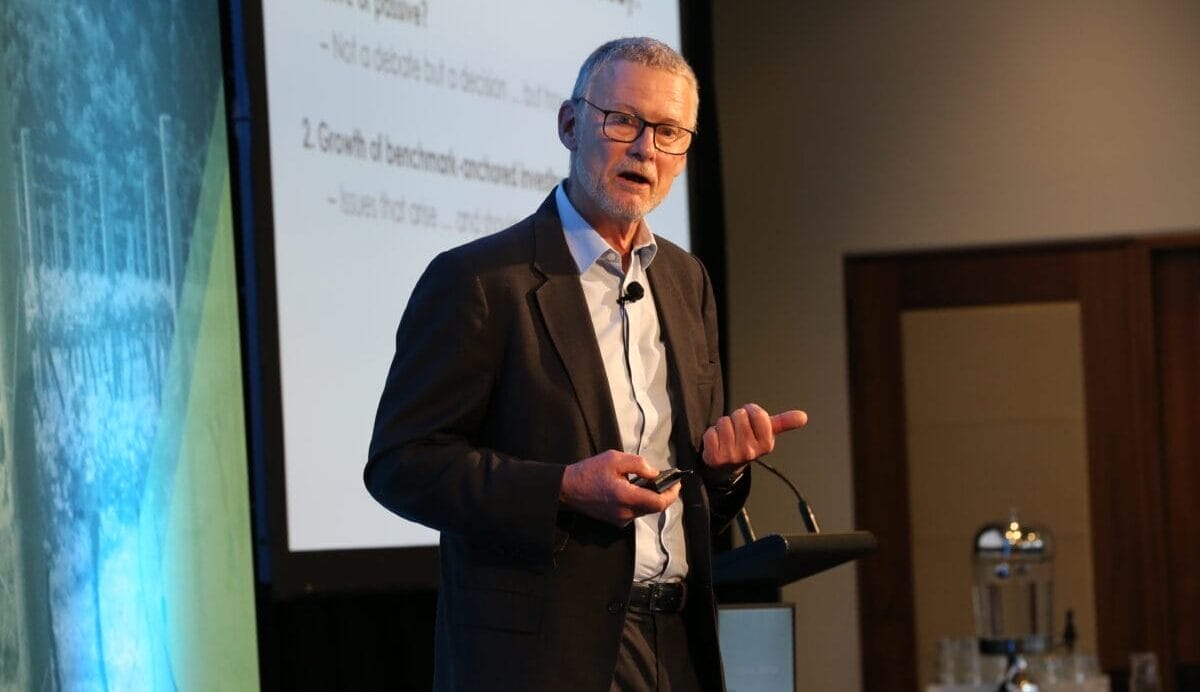
At the Fiduciary Investors Symposium, hosted by Professional Planner sister publication Investment Magazine, Warren proposed that funds look beyond merely adapting processes to fit the performance test and reconsider the broader focus of their investment approach. The three challenges he outlined reflect deeper structural pressures shaping how super funds allocate capital.
Regarding the debate of whether to invest actively or passively, Warren said the question should be framed not as an either/or question but rather as one of how to construct the best mix of both.
For example, asset owners can devise a checklist to decide whether they want to choose an active option over a passive cap-weighted index in a certain market.
This may include questions like whether a cap-weighted index is at odds with investment objectives (such as ESG goals); whether the cap-weighted index is inefficiently constructed (such as including non-performing companies); and whether the environment favours active management.
“Bear [these questions] in mind and think, if you think of the world this way, what should we actually be dabbling around in as a super fund?” Warren said.
The second challenge for funds is understanding the risk and opportunities of “benchmark-anchored” investing. There is no doubt that passive investing now represents a bigger proportion of the market, but whether its presence has fundamental impacts on market operations is a hotly debated idea, Warren said.
Critics of passive investing argues that it can hinder price discovery, create momentum effects, amplify index concentration and make markets less liquid. But others suggest index investing won’t have meaningful impacts on the market operations until the passive percentage is “very high” – the threshold itself is debatable, with some suggesting it could be as high as 90 per cent.
“This links into Your Future Your Super – what issues could arise from that [rise of benchmark-driven investing]? And the question here is, should you break the shackles, or do you stay tethered to the benchmark? To what extent is that an opportunity, or risk trading that off?” Warren said.
The final challenge for funds is managing size and capacity constraints in the Australian equity market. As funds grow their assets under management, Warren said there will be new portfolio limitations such as holding constraints (not being able to invest in smaller stocks) and trading constraints (higher transaction costs and opportunity cost).
“Another thing is competition versus diversity. If everybody’s doing the same thing, capacity is going to be absorbed more quickly than if you have a lot of disparate investors doing different things in the market. So you always got somebody on the other side,” he said.
Taken together, the three challenges reveal how policy settings and market behaviours have become closely linked. Warren concluded by urging the YFYS performance test review to focus on total portfolio returns.
The Conexus Institute is advocating for a “three-metric test” which incorporates two additional tests evaluating total portfolio returns on top of the current test, where funds need to pass two out of three.
The two new proposed metrics are ‘peer comparison of risk-adjusted returns’ and ‘risk-adjusted returns relative to simple reference portfolio frontier’.
“Broadening the test so it’s focused on total portfolio returns is really the way to go,” Warren said.
“What actually happens then is you dilute your ability to game the test, because they’re all three different tests. We just got to focus on just delivering the best results we can for our members, and hope that we get through the tests if we do that.
“That’s the mentality we want the industry to be in, just doing what’s best for members deliver the best returns possible.”
*The Conexus Institute is an independent think tank philanthropically funded by Conexus Financial, publisher of Professional Planner.