

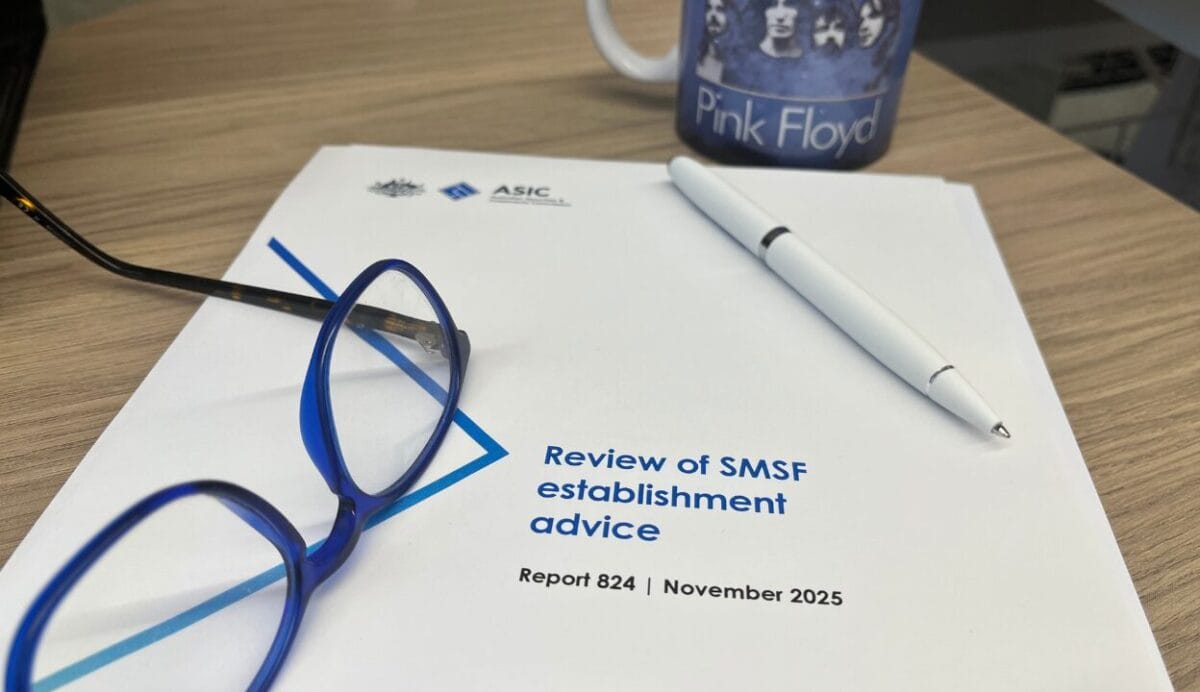

Over 60 per cent of advice files included in ASIC’s SMSF review failed to demonstrate compliance with the best interests duty, with the long-awaited report raising concerns about client detriment from inappropriately setting up SMSFs.
ASIC released Report 824: SMSF Establishment Advice, which covered only 100 advice files, and found just 38 demonstrated BID compliance.
Key issues uncovered in the report included advisers not basing all judgments on clients’ relevant circumstances, using the notion of “control” to recommend SMSFs, and acting as “order takers” without adequately investigating and assessing products suggested by the client.
Furthermore, ASIC raised concerns about conflicts of interest where advice was used to establish an SMSF to acquire off-the-plan properties through limited recourse borrowing arrangements.
Whether ASIC will take immediate action against advisers and licensees is another matter, but Commissioner Alan Kirkland said there was a “broad range” of options available to it.
“We will be considering all of those, so they include referrals to the FSCP [Financial Services and Credit Panel], banning orders that ASIC can make ourselves, undertaking further investigation and potentially pursing enforcement action against advisers or licensees,” Kirkland told Professional Planner on Thursday.
“[And] in cases where we’re seen a pattern of serious detriment, going back to the advice licensee and requiring them to do further investigation and to consider remediation.”
The report recommended that advisers should use professional judgement to assess whether an SMSF is suitable for their client and to factor in life insurance needs.
It recommended licensees should factor-in whether there is effective monitoring and supervision, and whether there is a clear conflicts-of-interest policy in place.
Furthermore, advisers and licensees shouldn’t prioritise their own interests over their clients’ when recommending an SMSF.
ASIC also raised concerns with ineffective pre-vetting of advice by licensees before distribution to clients. Among the 47 client files that contained records of pre-vetting the advice to establish an SMSF there were 33 instances where the adviser failed to comply with the best interests duty and related obligations, and that included 13 files that also led to significant concerns about client detriment in relation to the advice.
Small samples
SMSF Association chief executive Peter Burgess said the ASIC report was a reminder of the importance of high standards in SMSF advice but added the report needed to be viewed in context.
“It’s important to recognise that ASIC’s review was based on a targeted, risk-based sample of advice files, not a random selection” Burgess said.
“The advice files examined situations were, on face value, the establishment of an SMSF appeared to be unsuitable for the client. As such, the findings are not representative of the broader quality of SMSF advice currently being provided across the sector and this perspective is important.”
Acknowledging the small sample size, Kirkland said the report was part of the regulator’s effort to lift practice across the industry by specifically identifying and addressing poor practice.
“It’s a really important warning to the broader industry that we take very seriously because of the impact that inappropriate SMSF establishment advice can have on people’s retirement incomes,” Kirkland said.
The report used a selection methodology that included using risk indicators to identify the 12 advice licensees and 27 financial advisers to be included in the review.
Each file contained records of personal financial product advice to a retail client to establish an SMSF or make an initial rollover to an SMSF between 1 May 2023 and 30 April 2024.
Broader implications
In a media release accompanying the distribution of the report, Kirkland stressed the importance of high standards in SMSF advice, noting the recent Shield and First Guardian failures which have seen $1.2 billion in retirement savings impacted, including some superannuants who were moved into an SMSF.
Unlike the majority of the victims of the failed funds who may get remediation through trustees – as is the case with Macquarie and appeals for government assistance by the other trustees that held the products – right now there is no recourse for SMSF clients other than AFCA and the CSLR.
Aside from ASX-listed Sequoia-owned InterPrac Financial Planning, all other licensees involved have folded, meaning complaints against them would go to the CSLR.
“Collapses like those involving Shield and First Guardian show us the worst-case scenario for what happens when people receive poor advice to switch superannuation funds and make high-risk investments,” Kirkland said.
Overall, the SMSF sector accounts for around $1 trillion, or about a quarter of Australia’s superannuation system.
According to Australian Taxation Office data, 41,980 new funds were established in FY25, an increase from 33,032 establishments the previous year. The ATO estimates there are 653,000 SMSFs in total.
ASIC reported that over the past 14 years the number of SMSFs has grown at approximately double the rate of the Australian population.
















I constantly see SMSFs set up for a person who is unsophisticated or with a very low balance. Typically there is an “off the plan” property investment in there that isn’t worth the money paid for it 5 years later.
A person approaching retirement needs to evaluate the SMSF against the possibility of decreased capacity as they age.
There are WRAP accounts that give a person more direct control over their investments without the personal compliance burden.
Business real property in an SMSF is well worth considering.