
Produced in partnership with Netwealth.
Artificial intelligence (AI) has been embraced as a way ofc ompleting simple tasks more efficiently, but an expert who has consulted for major corporations and governments believes its application already has a much higher ceiling.
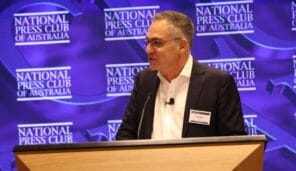
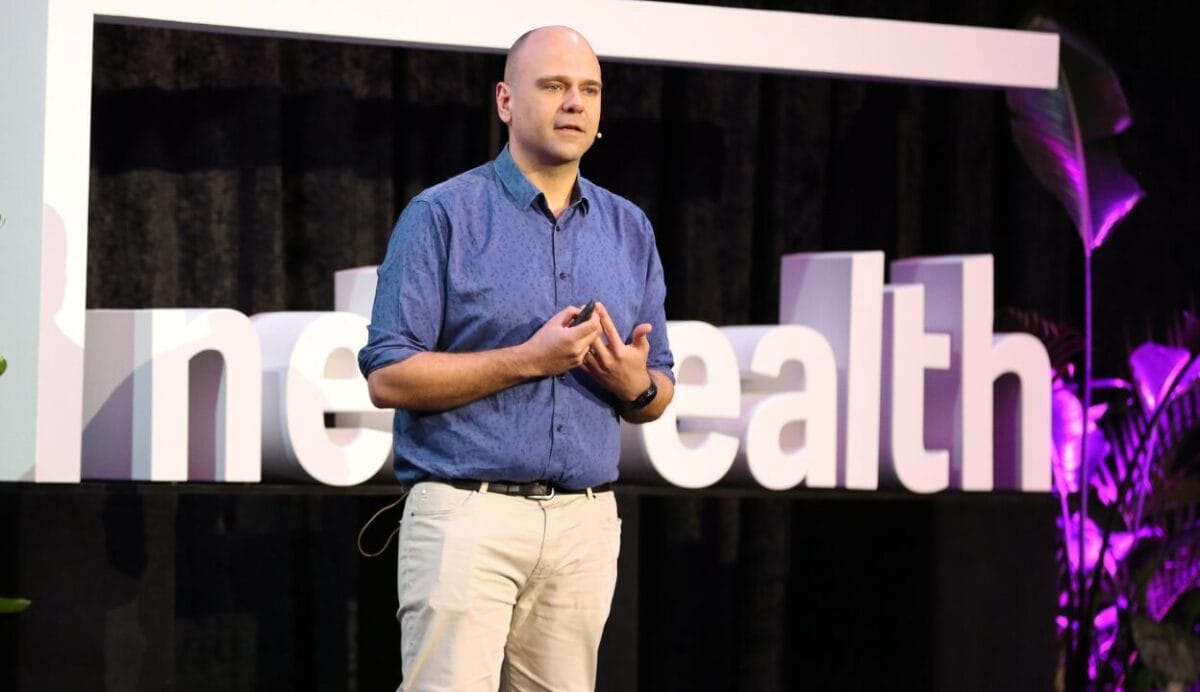
Pathfindr CEO Dawid Naude told the Netwealth Accelerate Summit to not view AI as a replacement for tasks that cost $15 an hour, but for tasks that cost $500 an hour.
“$15 an hour is about $30,000 a year which is what you pay for an offshore data entry resource in the Philippines or India. That’s typically how we’ll be using AI, data entry, consolidation, things like that – grunt work,” Naude told the summit on Thursday morning in Melbourne.
“I want you to much more think about it as a $500 an hour task capability which works up to $4500 a day and is what you pay for a McKinsey consultant to give it to a grad to use ChatGPT to then hand it back to you and then charge $4500 for a day. That’s how things are changing.”
Pathfindr has consulted for major organisations, including Woolworths Group, and the Victorian state government on getting results from AI.
“The last thing that any person in any organisation needs right now is not a PowerPoint deck telling them about AI strategy, we’re well beyond that – it’s ready to be implemented,” Naude said.
Naude said that the next two years will see accelerated growth in AI while noting the ebbs and flows of technological innovation.
“It’s right to be a little bit sceptical sometimes… but the next couple of years are going to have so much extreme growth,” Naude said.
“The next two years will be the fastest moving most rapid progress in history of any technology we’ve ever seen.”

Reflecting back on other technological evolutions throughout history, Naude noted that at the beginning is a trend that emerges followed by innovation.
“That’s not how tech evolves – we think it gets a little bit better each day but it’ s not at all how it works with any technology,” Naude said.
“If you think of the [Apple] iPhone in 2008 when it arrived in Australia at the beginning… all of a sudden you start doing banking on there, you get addicted to Facebook on there. It changes everything and then it peters out after that. That’s what we’re expecting in the next two years in particular.”
Another example he pointed to was the invention of flight and how that has developed since the Wright brothers completed the first sustained, engine powered flight on 17 December 1903.
“They had prehistoric-type flights but then we have air warfare like 30 years later,” Naude said. “You’ve got this big acceleration and a very compressed about of time.”
Naude pointed to three models of AI: the “assistant”, the “thinker” and the “creator”, the first model being the most utilised when the other two should be used more.
“How many of you have been using AI to date? If you’re using ChatGPT or Copilot, you’re giving it tasks you would typically give a grad. Somebody who’s much earlier in their career, somebody who’s low level,” Naude said, referring to this being the application of the “assistant” model.
“The one have most of you have been neglecting and I hope to inspire you to lean into today is the thinker.
“This is somebody who is a highly skilled, experienced PhD. They’ve read through 1000s of records and spreadsheets and data. They can do all sorts of scenario analysis, they’ve read every webpage there is, they can think incredibly deeply and they’re much better at giving you advice and interpreting things.”
The “creator” utilises newer AI models and can be used to generate multimedia assets like images and video rather than the traditional text application.
“The creator has gone crazy recently with Google’s Gemini that creates video really well,” Naude said.