
Produced in partnership with Netwealth.
Client satisfaction offers a compounding return for advice practices as levels rise the longer the relationship progresses, but that doesn’t guarantee loyalty, according to research from Netwealth.
At the Netwealth Accelerate Summit in Melbourne last week, the firm’s national key account manager, Rebecca Wokes, presented the findings of the Creating loyalty that lasts report which uncovered how client satisfaction increases over time.
“Despite this value increasing over time, clients are still leaving the adviser,” Wokes said.
“This really underpins how we’re delivering and what we’re trying to achieve and making sure we’ve got good, consistent engagement there.”
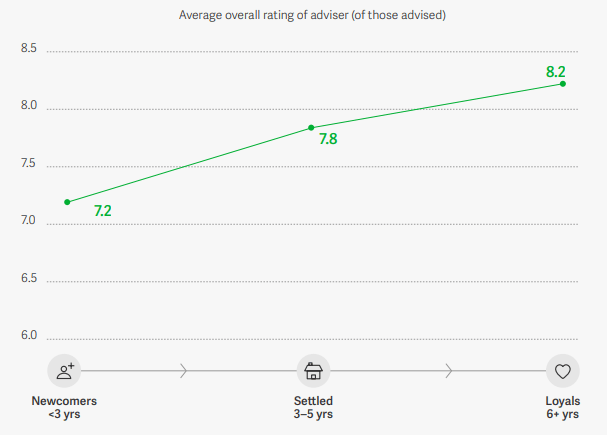
The research placed clients into three categories based on tenure: “newcomers”, where the relationship had existed for less than three years; “settled” which covered three to five years; and “loyals” who had been with the adviser for six years and over.
On a scale of one to 10, with the higher figure representing “exceptional value”, the research showed a shift as the client relationship progressed over time.
Newcomers rated an average of 7.2 out of 10 which increased to 8.2 once they reached the loyalist stage.

Client satisfaction rating based on length of relationship
“The good news is that the research clearly shows that as long as a client is with you as an adviser, the satisfaction levels actually increase,” Wokes said.
But despite the satisfaction levels that were found, the research found less than 50 per cent of clients said their adviser was delivering on the factors they value the most.
Wokes said that although these clients are satisfied with their advisers, they could still be underserved on what they expect.
“This disconnect between satisfaction and value is further supported by the research and when we looked at the main reasons that a client is leaving their adviser, the main reason that come up was this expensive cost,” Wokes said.
“The other area was that they felt that perhaps their finances weren’t quite complex enough, although at some point perhaps they were because that’s why they initially engaged with an adviser in the first place.”
The report highlighted the 12 most important value drivers: goal-based advice, aligned investment options, guidance for the unexpected, innovative advice, operational transparency, communicate often and proactively, continual reassurance beyond markets, knowledge for empowerment, prompt and timely support, frictionless digital experience, rewarding clients, and contributing to the world.
“From a behavioural science perspective, goals-based advice is really there to try and [get] clients thinking about the short term and get them thinking more about the longer term, setting those goals on what they achieve,” Wokes said.
“Our data shows that goals-based advice will actually grow and be more relevant the longer the client is with you. When we look at the ‘loyals’ they value the goals-based planning more and we actually found from the research as well that they like to engage and almost co-create some of those goals with you.”
Wokes said the research found clients want their investments to be aligned with their identity.
“Particularly for the loyals, they really want you to recognise their investment preferences and take that and align their investment portfolio to that,” Wokes said.
For guidance for the unexpected, this means supporting client during unexpected events, but over time this can expand to more complex topics like SMSF rules, changing tax regulations or selling businesses.
Clients value the concept of innovative advice early on, but over time become more conservative as they gain confidence with tested strategies where they have seen the track record.
When it comes to operational transparency, Wokes said this meant showing clients what happens behind the scenes.
“If you’re able to demonstrate what you’re doing for those fees, that can really open it up and gain some value and trust from your clients,” Wokes said, pointing to fees as one aspect of transparency, with others including how the advice process works and why they’re being put into a particular process.
When it comes to continual reassurance beyond markets, the report said continual reassurance about the adviser’s expertise helps clients feel validated in their choices and reinforced their confidence in the service provided.
By providing targeted education at each stage of the client journey, advisers can empower clients with knowledge but also leverage “authority bias” by demonstrating their specialised knowledge.
Prompt and timely support helps clients feel like a priority, reducing any friction that might push them to look elsewhere, and increases their sense of reciprocity by building trust and lowering uncertainty over time.
For a frictionless digital experience, this was most likely by using a client portal which was supported either via smart phone or desktop and clients could prefer either.
When it comes to rewarding clients, at least half – regardless of tenure – expect loyalty incentives including reduced fees (53 per cent for newcomers, 50 per cent for settled, 56 per cent for loyals).
The final engagement driver, contributing to the world, meant maximising community impact either by engagement through community events or by pro bono charitable work.