
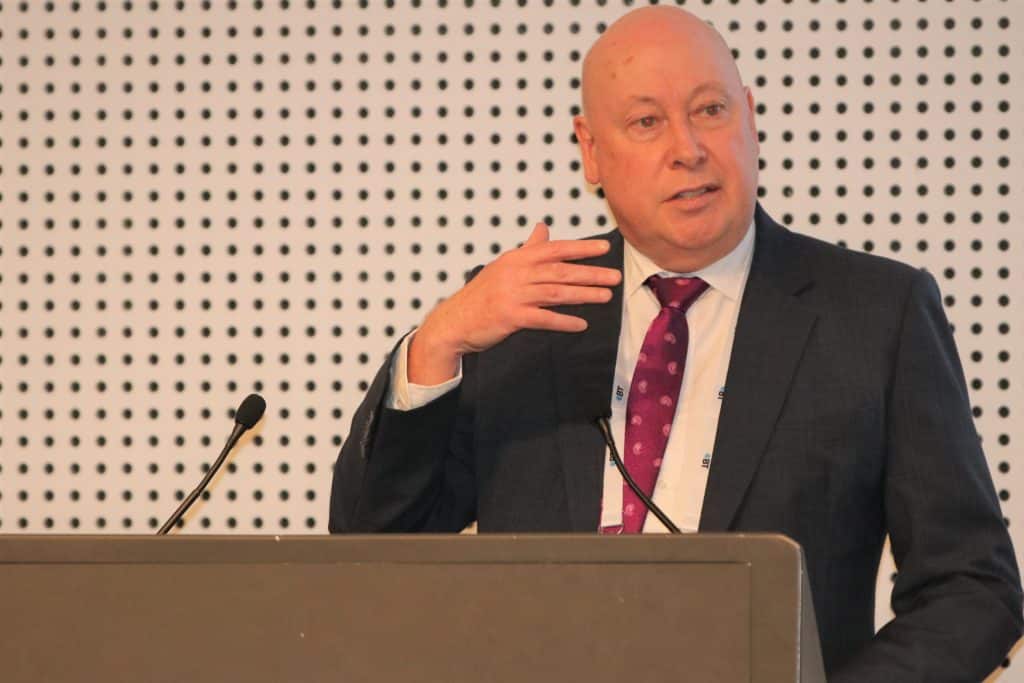

FASEA has no immediate plans to submit changes to the wording of the most controversial parts of the Code of Ethics, with the statutory body’s CEO Stephen Glenfield confirming he would like to see it road-tested for a year before changes are considered.
Glenfield said he wanted to see the code “bedded down” first before changes were made but that the wording of the code itself “was not set in stone forever.” Glenfield made this comment on stage at the FPA’s Professional Congress in Melbourne on Thursday in response to a question from the FPA’s head Dante De Gori on whether FASEA had the “appetite” to amend the code.
On the sidelines of the conference following his session, Glenfield told Professional Planner he thought 12 months would be a reasonable amount of time for the code to be assessed.
“You want to see the Code bedded down first, you want to see how it performs and whether it’s delivered what it intended to,” Glenfield said on stage. “But it’s not set in stone for ever.”
FASEA is in a position to lobby for changes to the current code, which would require a legislative amendment.
 Glenfield was asked by a crowd member during the presentation why in Standard 3 of the Code FASEA chose go above “300 years of common law in the legal and accounting profession”. The question was seconded by De Gori, who said: “We have concerns around the written letter of it, we think it does go above and beyond any comparable duty… hence the reason why we’re asking if it will be amended.”
‘Looking at all the enquiries that have taken place and the outcomes in financial services over recent years,” Glenfield responded, “the regime of relying on disclosure and management has not worked in our view.”
Reasonable concerns
The FASEA CEO took the opportunity to address some of the “key feedback” he received during last week’s eventful round of consultation meetings with stakeholders, starting with concerns expresses by advisers and licensees regarding their ability to amend their “practices or business roles” by January 1.
‘FASEA considered that concern is a reasonable one,” Glenfield said.
The implementation of any new standard takes time, he explained. ASIC’s recent announcement that it would take a facilitative approach, he added, was reasonable. Glenfield warned, however, that principals should use the time to step back and assess how they stand against the current standards.
“I expect that when you do so, you’ll find that you already comply with most of the Code,” he said.
On concerns that their remuneration would put advisers in breach of Standard 3, Glenfield again exhorted advisers to look at the Code in its entirety, taking into account best interest duty, fair and reasonable fees, whether the client understands the advice and if they are getting value from it.
“The code does not seek to ban particular forms of remuneration, nor does it determine that particular forms of remuneration are always in actual conflict,” he stated.
Glenfield reassured advisers that FASEA is not looking to regulate fee structures and business models. “Simply put, it can’t,’ he said. ‘By law, the Code only applies to relevant providers… it does not apply to the broader business those advisers work for.”
On referral fees, he noted that the Corporations Act 2001 already precludes advisers from accepting benefits from a third party. The business, however, is not regulated by the Code of Ethics.
“This means that advisers cannot receive referral fees directly from third party, it does not impact referral arrangements that fall outside the legalities of the Code,” he said.
Contrary to concerns, Glenfield said, scaled advice was not under threat.
“The guidance makes a clear point that a limited scope engagement can be a highly effective tool to provide client advice,” he said. “The Code is not seeking to remove this type of advice.”




















Leave a Comment
You must be logged in to post a comment.