

Although the costs of licensing shouldn’t be the driving factor in your decision on licensing, it is important that you have unbiased and credible information to consider your options.
When examining costs, it’s important to break it down between initial and ongoing costs. In both instances, I have provided some indicative costings for both self-licensing and authorised representatives, including SMSF specialist authority and strategic authority. You can download interactive calculators and input your own figures at L4A.com.au
Initial costs
One of the largest and unavoidable costs for most accountants will be their initial RG 146 training. If you are only looking at a basic level of licensing (either self-licensed or authorised representative), the cost is approximately $1200. For the full limited licence, or more extensive accountant authorities that cover areas such as limited recourse borrowing arrangements, investment strategies et cetera, you will need to complete up to four units of training and the cost is likely to be closer to $2000. You can expect to pay more than this if you want to attend face-to-face workshops.
Another expense often not factored in is the cost of registering a new company. This is often a requirement for authorised representatives. But even if it’s not mandatory, it is something accountants may want to consider from a risk management perspective.
Licensing requires commitment, and the payoffs can be rewarding when the scope of advice to clients is extended. However, licensing is a complex environment and if you are unfamiliar with it, ensure that you engage the support of specialist licensing consultants, as they are likely to save you time, money and stress in the long run.
Table 1 (click to enlarge) includes an allowance for a legal and compliance consultant for the self-licensed option and the costs we typically charge to assist accountants in finding an authorised representative option to meet their needs.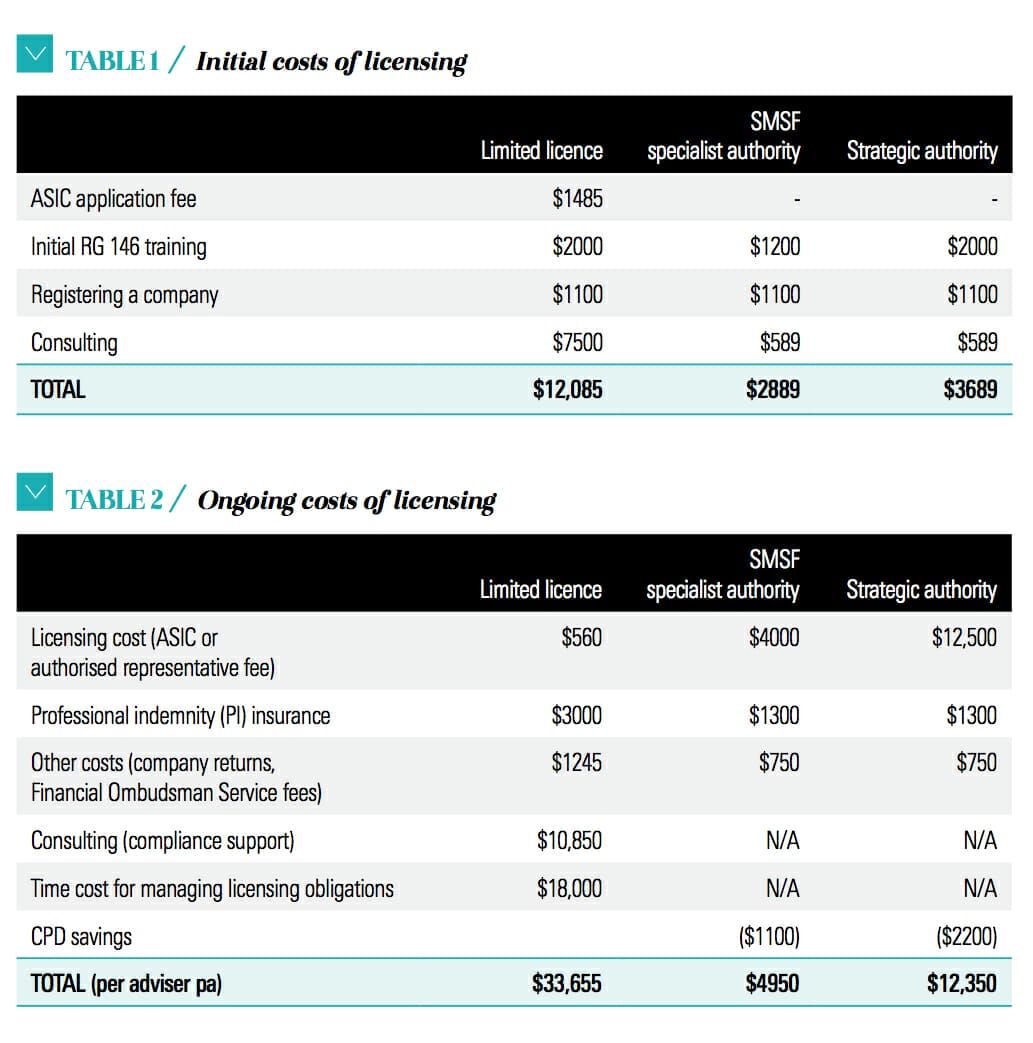
Download the four parts of Kath Bowler’s series on accountant licensing solutions
Ongoing costs
As with initial costs, some of the ongoing costs are fixed (licensing costs, professional indemnity (PI) and other costs), whereas others depend on the amount of time and external support you choose to invest.
Time cost is one of the biggest variables – and unknowns. I have assumed that there won’t be any additional time required to provide the extended advice, as this will be a “redirection of time” rather than “additional” time. However, if you have your own licence, there will be additional time in managing your licensing obligations – which would be taken care of by your licensee if you become authorised. Table 2 has allowed for one day per month for an administration person and one day per quarter for a referral partner.
Table 2 (above, click to enlarge) includes an allowance for ongoing consulting support. I would encourage anyone new to licensing to consider engaging compliance and licensing consultants, at least initially, until you understand and are comfortable with your ongoing requirements.
Cost variations
With the authorised representative option, I have seen many examples that are much cheaper than the guides I’ve given you in the tables. Based on my research, I’ve identified four reasons why the cost varies. Some of these are valid reasons that will sit comfortably with some accountants, others are not.
1. Authority restricted: The typical prices I have seen in the market (and I’ve seen more than 20 different options now) are: $3000-$5000 for a very limited authority, $10,000-$15,000 for a strategic authority and $15,000-plus for comprehensive authority. If you are looking at your options and you think it is a broad authority, but you are paying less than $10,000, it could be that your authority is more restrictive than you think.
2. An expectation of referrals: This is by far the most common reason for cheaper licensee fees. I have comprehensive authorities as low as $3000 a year, but in return, all investment recommendations are expected to be provided to someone who is licensed within the same network. This is not necessarily a bad thing, particularly if your existing referral partner is part of that network. The key is to go in with your eyes open and understand any referral expectations that may exist.
3. You don’t get much for your money: You want to know exactly what you’re getting for your money. If you are only receiving a few of the support services below, this could be the reason why the fees are so cheap.
- Compliance
- Training
- Technical support
- Software and templates
- Paraplanning
- Research
- Branding and marketing support
- Practice management
- Induction and transition
4. Poor compliance: The final reason I’ve seen for cheaper fees is poor compliance. Licensees who have chosen a “minimalist” approach to compliance are able to offer significantly discounted licensee fees.
If none of the other reasons for cheaper fees apply, this is likely to be the reason; and if that’s the case, turn around and walk away. If cost is that much of an issue that you are prepared to select a low-cost licensee, knowing they have poor compliance, then perhaps referrals are a better option for you.
While costs are an important factor in your licensing decision, don’t rule out the services that your clients want from you and the long-term benefits to you and your business. And of course, keep in mind that when it comes to costs, read between the lines and consider your information sources and their agendas.