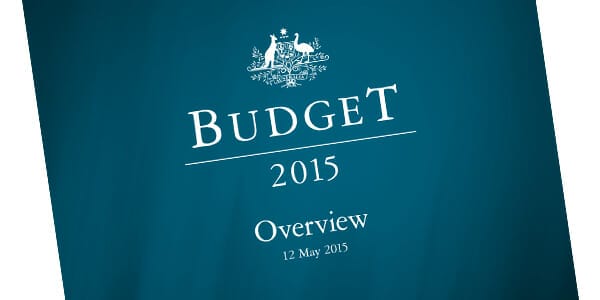

Retirement planning strategies have escaped the need for a major rethink after the government last night confirmed it would make no unexpected or detrimental changes to superannuation in this parliamentary term.
And small businesses – those run by financial planners themselves, as well as those run by the clients of financial planners – have been singled out by the Financial Planning Association (FPA) and the Institute of Public Accountants (IPA) as the big winners.
The chief executive officer of the Assocaition of Financial Advisers, Brad Fox, said that “the outcome the budget needed to achieve was a shift in the mindset of Australians from pessimism to optimism, but cautioned against forgetting realism”.
“The budget represents a realistic attempt to unfreeze the wheels of small business across the economy,” Fox said.
“If as a nation we are to get out of this period of financial inertia, then a new wave of confidence to invest, to innovate and to employ needs to be created. In our experience that always starts with the brave and resilient small business sector as the major employer in our economy.”
This article will be updated throughout
the day with the latest reaction and responses
The chief executive officer and managing director of the SMSF Association, Andrea Slattery, said stability for more than one million SMSF trustees and members was welcome.
“We have been active in advocating for Governments to stop tinkering with the superannuation system and it is pleasing to see the Coalition Government is heeding this advice,” Slattery said.
“The stability to superannuation in the current Budget cycle allows SMSF trustees and members to take a deep breath and assess their long-term strategies without having to confront constant regulatory change.”
It was also welcomed by the Association of Superannuation Funds of Australia (ASFA). ASFA said other measures, such as making it easier for members to be reunited with their lost and unclaimed super, and changes to child care rebates to make it easier for women to return to work, will also provide a significant boost to the retirement savings of hundreds of thousands of people in the community.
The Financial Services Council also welcomed Treasurer Joe Hockey’s announcement that superannuation would be left alone.
Sally Loane, CEO of the FSC said: “Tonight is the first Budget in recent memory where there has been no tinkering with superannuation. The government has exercised prudence in keeping changes to superannuation out of the Budget cycle and putting them into the broader and more sustainable policy agenda.”
The FSC welcomed the tightening of pension eligibility rules.“We need to build a national retirement system that removes dependency on the public purse. Welfare is for Australians who need a safety net. Superannuation is the vehicle to help Australians save to provide for their retirement, and we expect the tax white paper process to focus on how to improve the super system to deliver this outcome,” Loane said.
Consumer group CHOICE described the Budget as a mixed bag, containing both sweet and sour elements.
“Fewer retirees will be eligible for the aged pension due to a tougher assets test from 2017 but around 170,000 retirees who remain on the pension are likely to receive more as the assets-free threshold has increased,” it said.
Meanwhile, financial planning businesses will benefit from tax cuts and an increase in the accelerated depreciation threshold.
Dante De Gori, general manager of policy and conduct at the FPA, said the association has some concerns with the proposed changes to the asset-test for part-pensioners, but it broadly welcomes the initiatives announced for small businesses.
“A welcome initiative of tonight’s Budget is the $5.5 billion Growing Jobs and Small Business package, which is aimed at supporting small businesses so they can invest and grow more,” De Gori said.
“This package will assist financial planners and consumers alike – financial planners are often small business operators themselves and they also provide advice to many Australians who run their own business or are seeking to start up their own business.
“Specifically, the reduction in the company tax rate and a 5 per cent discount for sole traders along with an immediate tax deduction for items purchased for under $20,000 is a fantastic initiative.”
“As promised the Government has delivered a 1.5 per cent corporate tax cut for those small businesses which are incorporated and based on the existing $2 million turnover test,” said IPA chief executive officer, Andrew Conway.
“Our concern that only incorporated businesses would see such a tax break has been alleviated with non-incorporated entities receiving a tax discount of 5 per cent up to the cap of $1,000.
“This is the first small business tax cut in 13 years, so it is long overdue.”
“Particularly pleasing is the increase in the accelerated depreciation write off threshold of $20,000 (currently $1000 and previously $6500 under the previous government), which is of significant assistance to small business cash flow,” he said.
However, Australia’s largest prepare of tax returns, H&R Block, has warned of traps in the Federal Budget’s introduction of a $20,000 instant tax deduction for asset purchases by small businesses.
Mark Chapman, Tax Communications Director with Australia’s largest firm of tax accountants, H&R Block, welcomed the move.
However Chapman has warned that the generous tax break is likely to tempt some business owners into making mistakes – and has provided tips to “prevent the tax break going sour”.