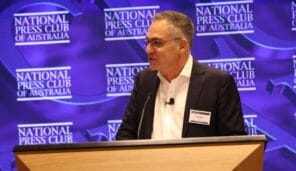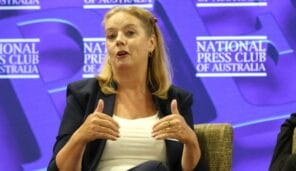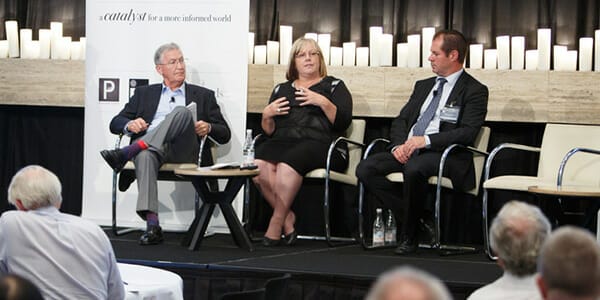

Older clients require a specialised level of financial planning advice that clearly distinguishes them from other client groups, according to David Williams, founding director of My Longevity.
“Especially when you deal with older people, you aren’t dealing with a class, but with an individual. If you’re using the average, then you’re not advising them correctly,” Williams told the 2015 Conexus Financial Post Retirement Conference.
One common way planners often generalise is by relying on life expectancy tables when assessing clients’ longevity planning. Williams (on the left in the picture) believes these should not be used for individuals.
He said figures from the Australian Institute of Health and Welfare, which compare different age groups’ disability-free years, dependent years and average age of death, illustrate the imperative for advisers to address the various issues around helping clients’ funds last throughout their retirement.
“As advisers, you can help shape the way your clients move through these stages,” Williams said.
While acknowledging the sensitivities around longevity discussions, he said there are a number of processes advisers can use.
“I think estate planning must be discussed much earlier in the conversation, not just plugged in later,” he said.
Financial literacy tests
For ageing clients, including self-managed super fund trustees, Williams said there should be tests for ongoing financial literacy, much like those older drivers are required to pass once they exceed a certain age.
“I think planning must change, it can’t go on being just financial,” he said.
Louise Biti, a director of Strategy Steps, said that the conversation needs to change. She said the provision of aged care, for example, had evolved so there were many more options for clients in retirement, depending on their specific age and.
“People need to be prepared for aged care at all ages,” she says.
Biti believes baby boomers are changing the concept of aged care. “They’re not just asking how long, but also how well they want to live in retirement.” She says they are also exploding the diminishing income myth. “It’s not about ‘as we get older we can live on less income,’” Biti says.
She says conversations between advisers and post-retirement clients need to be framed more positively, for instance, acknowledging the substantial subsidies people already receive on aged care. “This is part of developing your value proposition for these clients.”
Tailoring the message
Steve Smith, director of psychological services at Prova, said advice can be delivered more effectively if advisers understand people’s basic personality types, what aspects of personality remain fixed over time, and how personalities can change during periods of stress – which is common when issues around aged care and incapacity have to be discussed with elderly clients and their families.
Smith said advisers should learn how to recognise stress, and how to defuse potentially highly charged meetings.
Smith said personalities can be divided into four main types, and in most people one of the four is dominant , while one is less dominant.
I-type personalities are intuitive, visionary and expressive; S-type personalities are feeling, interpersonal, emotional and value relationships; C-type personalities are organised, focused on detail and task-orientated; and D-type personalities are logical, and focused on performance and results.