
Two years short of a planned five-year engagement with the financial service giant AMP, Futuro Financial Services is now looking forward instead to life as a newly single licensee.
AMP acquired 10 per cent of Futuro in 2012, and initially intended to move to 100 per cent ownership by 2017.
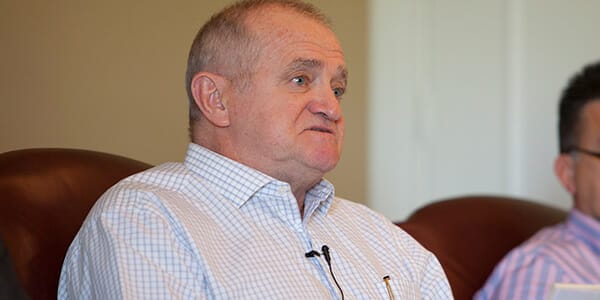
Yesterday Futuro announced that for a range of reasons the planned AMP union has not gone as planned, but the managing director of Futuro, Dennis Bashford (pictured), says there are no regrets, the separation is amicable, and Futuro has ambitious growth plans.
During the time of its link with AMP, Futuro’s adviser numbers shrank to about 80. Bashford says a priority will be to rebuild number “back up to 100, as quickly as possible”.
He says most of the adviser who have left the group have left the industry altogether – they have not been dissatisfied with Futuro or AMP’s part-ownership of it. He says the company’s revenue has not declined as adviser numbers have shrunk.
“The guys who have retired have basically sold [to other advisers] within the group,” Bashford says.
“So the dollar numbers are fairly impressive.”
New dealer fees
He says Futuro has introduced a new dealer fee split arrangement, where practices with higher compliance ratings get “a small discount”, and it has implemented a “virtual office” to help practices with administration. This has seen on Futuro practice increase revenue by 70 per cent, with little additional cost, and Bashford says the back-office assistance can help all practices become more efficient.
Futuro joins a growing list of notable licensees to have bought back institutional equity stakes, including Infocus Wealth Management and Fortnum Financial Group, who bought out MLC and ANZ respectively.
“I think that with the changes we’ve experienced in recent times, the [acquisition] made a lot less sense,” Bashford says.
He says that in the years since Futuro sought the shelter of an institutional owner, “the industry really has become polarised”.
“You are either with the institutions, or else you are an independent,” he says.
“The institutions are moving that way as well – they are becoming far more prescriptive in terms of the products that their networks have access to. If they’re starting in that direction, and with Futuro having a strong independent focus, then it was just a divergence.”
Planners polarised
Bashford says polarisation is also apparent within the ranks of financial planners.
“You are either passionate about being with an independent, or you are passionate about being with an institution,” he says.
For all the apparent polarisation, however, Bashford says Futuro and its advisers experienced little pressure from AMP to toe a particular product or platform line.
“I’m not trying to duck the question; I just think the world is different now,” he says.
“You are either one or the other. When we did the deal with AMP, which was really with Charter – and I still think Charter is the closest thing you are going to get to an institutionally owned independent [licensee] – there was a strong trend towards having a big brother standing in the background to provide stability.
“A ‘sense of comfort’ is probably the best way of putting it. But now, a sense of comfort is less important.”
Uncertainty subsided
Bashford says regulatory uncertainty has largely subsided, making the path ahead clearer for independently owned licensees, and significantly reducing the need for institutional stability.
“First of all, I think there’s clarity around FoFA [the Future of Financial Advice changes],” Bashford says.
“In markets, it doesn’t matter if things are bad. If things are bad you can at least learn to live with it. There’s things you can do that still allow you to grow.
“Now there is clarity with FoFA, what we have now is stability. So we can go forward now with some confidence. That’s less to do with [how bad] the environment is, and more to do with stability of the environment.”
Futuro will be buying back the AMP stake “from our own funds”,” Bashford says.
He says the 2012 deal was deliberately struck “at a fairly low amount”.
“It was supposed to be a five-year term, no one know what is going to happen over five years, so we purposely made it a low amount, so if either party wanted to go their separate way…we could,” he says.
“AMP have been pretty good about all this. I think there’s a fair amount of goodwill and respect from both parties.
“We see ourselves growing pretty quickly in the next 12 months.”