


Planning for what will happen to a fund when members lose capacity or die involves finding all the original documentation and ensuring everything is properly executed. Bryce Figot explains.
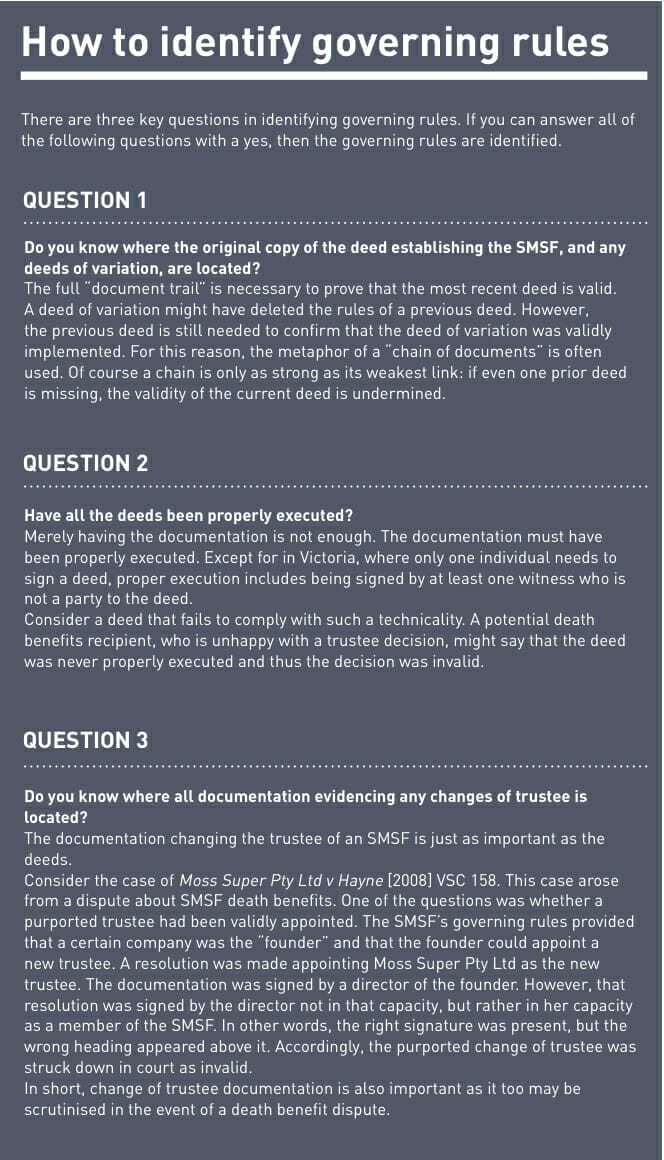
Many Australians have significant wealth in their self-managed superannuation funds (SMSFs). Accordingly, it is vital to properly plan for what will happen to their SMSFs upon loss of capacity and death. In planning for this, most forget about the first step: identify the governing rules of the SMSF. Once this step is covered, then more “exciting” steps can be covered (for example, taxation strategies). However, skipping this step is like trying to build a house without proper foundations.
WHAT ARE GOVERNING RULES?
The expression “governing rules” refers to the terms that set out how the SMSF must be run. In other words, governing rules are essentially the “constitution” of the SMSF.
Typically they are found in a deed. Naturally, as the SIS legislation changes, the governing rules need to be updated. Ac- cordingly, it is quite common for an older SMSF to have several deeds. The first deed is often a deed evidencing the creation of the SMSF and its initial rules. The subsequent deeds often delete the previous rules and introduce new rules. Such deeds are often called “deeds of variation”.
WHY IS IT IMPORTANT TO IDENTIFY THE GOVERNING RULES?
There are many reasons why the governing rules are vital for SMSF succession planning.
One reason is that trustees are under a duty to ascertain the governing rules of the SMSF. Failure to ascertain them can result in trustees – and their advisers – being liable to be sued by any beneficiaries of an SMSF. Remember that the class of beneficiaries of an SMSF is much broader than the class of members. For example, in Kafataris v Deputy Commissioner of Taxation (2008) 172 FCR 242, an SMSF had only one member but the judge counted at least 21 beneficiaries.
‘The perfect legal solution is to seek a court order. However, this is time-consuming and costly’
Another reason is that there are many vital SMSF succession planning questions that are answered by the governing rules (and not by the SIS legislation).
For example, whether someone has been validly appointed as an SMSF trustee is determined by the governing rules. Similarly, the governing rules stipulate when someone starts and stops being a member. Also, if a trustee wishes to pay death benefits as a pension, the governing rules must so allow it. In recent times, there have been various court cases in which these points were considered. In reaching their answers, the judges relied almost exclusively on the governing rules.
Accordingly, in the event of any death benefit dispute, the governing rules will be closely scrutinised. Also, the ATO might scrutinise the governing rules to determine whether a pension ceases upon death. (See draft taxation ruling TR 2011/D3.)
LOST DOCUMENTATION
The above is all well and good. But sometimes documentation is lost. There are several solutions. The first solution is to tell the SMSF trustees that a lost deed or change of trustee documentation compromises the SMSF forever. Sometimes the SMSF trustees then conduct a more thorough search and find the missing documents. In the event of truly lost documentation, the perfect legal solution is to seek a court order. However, this is time-consuming and costly. Accordingly, few SMSF trustees ever wish to pursue this option.
Another solution is to establish a new SMSF and roll all benefits of the old SMSF to the new SMSF. The old SMSF could then be terminated. However, this can give rise to administrative burdens and tax liabilities, as well as other issues. The most popular option is to draft a deed of variation. Assuming all SMSF beneficiaries sign the deed, there is case law suggesting this will be effective. See Bowmil Nominees Pty Ltd [2004] NSWSC 161. However, this too has its problems. Remember that an SMSF will typically have many more beneficiaries than it has members. Accordingly, getting all the beneficiaries to sign can be hard. Further, some beneficiaries could be minors and therefore unable to sign. Nevertheless, many trustees view this as the most practical solution to a lost deed.
Identifying an SMSF’s governing rules is the first step when planning for what will happen to that SMSF when members lose capacity or die. It involves finding all the original deeds and the change of trustee documentation and ensuring all are proper
ly executed. Once this is done – and any defects addressed – then the next steps of SMSF succession planning can be tackled.
Bryce Figot is a senior associate at SMSF law firm DBA Lawyers. Bryce can be contacted at bfigot@dbalawyers.com.au
















Leave a Comment
You must be logged in to post a comment.