
Advisers will need to upskill in specialty aged care advice to meet an expected surge in demand for client guidance in what can be a complex and emotional area, including decisions to sell the family home, says Challenger’s general manager of advice services, John Carnevale.
Carnevale says aged care advice is following SMSFs and broader retirement planning as the next big area of growth in advice.
Aged care has been the hottest topic for advisers seeking technical, legislative and strategic support from Challenger’s technical services team in the last six months, he says.
“Advisers and accountants are seeing their clients demand help in this space,” Carnevale says. “It’s a complex area and in a lot of instances clients are requiring time-critical advice. The more educated advisers are, the more capable they are of providing advice in the best interests of the clients.”
He notes the number of Australians aged over 85 is set to more than double over the next 30 years, according to the Intergenerational Report, which will drive demand for aged care advice.
The comments come as Challenger announced that Renae Anderson from Industry Fund Services and Forward Financial Group’s Sara Huang were the winners of scholarships to complete the University of New South Wales aged care planning course, Australia’s first purpose-built aged care planning course.
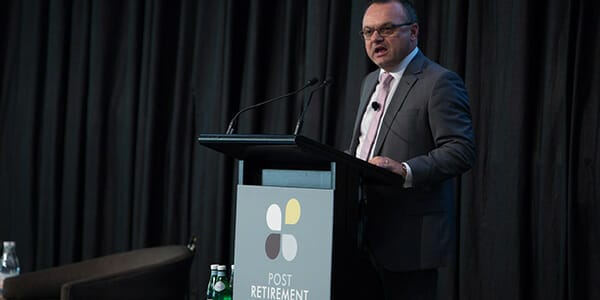
Post Retirement Conference
Applications for the scholarships were open to delegates at this year’s Conexus Financial Post Retirement Conference in March. Conexus Financial is the publisher of Professional Planner.
Carnevale says the scholarships are part of Challenger’s support for the ongoing professional development and education of financial planners.
Scholarship winner Renae Anderson, a financial planner from Industry Fund Services working with CareSuper members, says in her experience aged care advice has been relatively uncommon, but all the indicators show there is going to be a huge demand for it.
“I need to be ready,” she says.
Anderson says aged care planning requires consideration of many options, and needs a framework and process to follow in order to deliver the best outcomes, both financially and emotionally.
Anderson says a problem in aged care advice is the infrequency of individual planners advising on the topic.
“The rules are also often complex and constantly changing,” she says.
Whether or not to sell the family home is typically the biggest decision in aged care planning, Anderson says, and the most difficult when it comes to balancing emotional preferences with financial commitments.
Upskilling is vital
A general lack of experience across the industry and the complexity of the area means upskilling is vital.
Anderson has attended a number workshops and adviser briefings on aged care planning. “It’s time to learn it properly,” she says, adding that is what attracted her to the Challenger scholarship.
Carnevale agrees aged care planning is a complex area of advice given the need to be across a wide range of issues such as fees and charges and legislative changes. Decisions also need to be made with estate planning, pensions and tax in mind.
But aged care decisions also often need to be made quickly.
Carnevale says a retiree can go from being healthy, to suddenly having their adult children taking them out of the family home and placing them into residential aged care.
In a short period of time an aged care facility needs to be found, along with funding. “All while there’s a lot of emotional upheaval going on,” he says.
Carnevale says he is aware of a number of instances where aged care decisions were made without advice, and this led to suboptimal outcomes.
He says given the specialised nature of aged care advice, many advisers are grappling with whether to become a specialist adviser in the space themselves, support a staff member to upskill, or to work with an outside specialist adviser.
Support for UNSW
Challenger supported UNSW’s development of the aged care planning course and provided tools and research.
The course is available face-to-face in Sydney, but is also being delivered nationally via distance learning.
UNSW’s course covers the ageing demographic, residential and home care fees, technical strategies and tax. It also covers the emotional aspects of aged care and recognises aged care as a process of retirement planning that is often sensitive and time-critical for residents and their families.
Aged care advice “is a growing trend and advisers need to upskill in this area”, Carnevale says.
“While there is a strong focus on the active phase of retirement, there is increased demand for support around the passive and frail stages of retirement planning, and how it relates to aged care.”