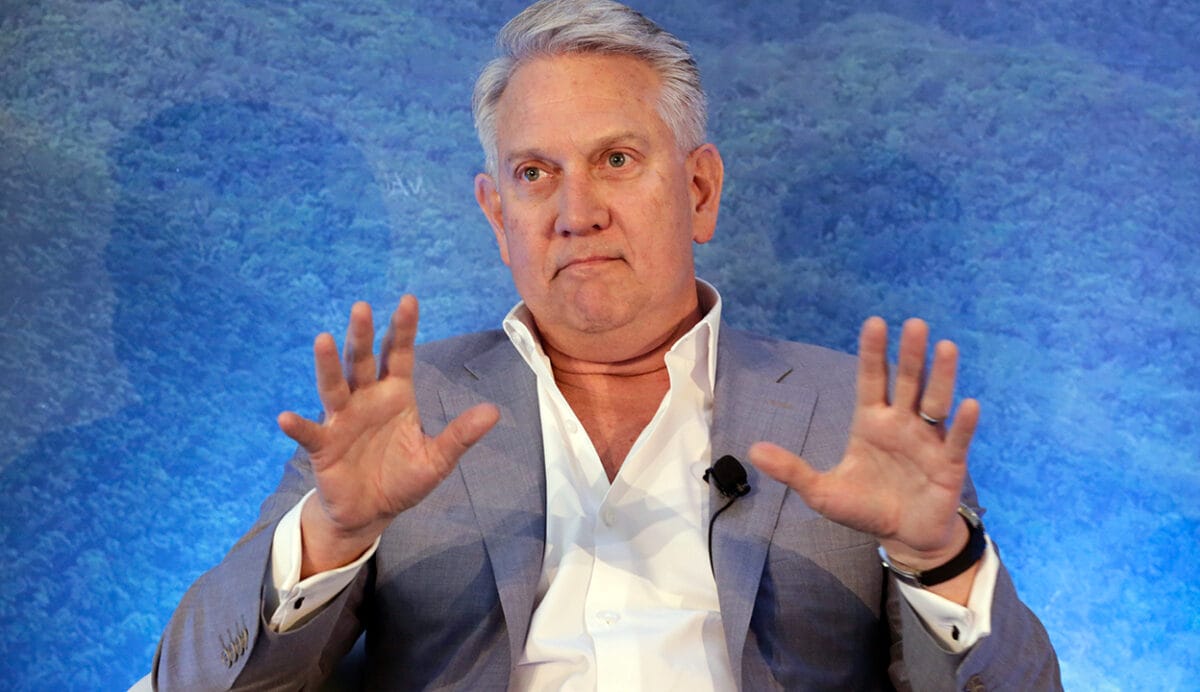

Barry Lambert’s listed wealth management business Countplus is in discussions with more than 20 high-quality financial planning practices about Countplus subsidiary Advice389 taking an equity stake in the businesses.
Discontent with existing licensees is a major factor in financial planning firms entering discussions, says Advice389 chief executive officer Pierre Kraft.
He says the Advice389 offer is structured to provide capital to the planning businesses, and to help them avoid licensee-related issues that can be disruptive to servicing clients and sustaining business growth.
Kraft is executive chairman of Australian financial services licensee Total Financial Solutions (TFS), a wholly owned subsidiary of Countplus, as well as CEO of Advice389 – a vehicle set up specifically to buy into financial planning businesses. He says discussions with planning firms are ongoing.
“It’s a long process,” Kraft says.
“And we’re not in any hurry. So we’ve got a five-year time frame and the intent is we’d look to announce our first firm in quarter three of this year and make an announcement around that.”
Advice389 will initially take a 30 per cent stake in target businesses, moving to as much as 60 per cent.
“Initially when we talk to them we come to a landing around profit-based multiples,” Kraft says.
“We support them in their growth and then assuming they are able to grow and they tick both qualitative and quantitative elements, we then invite them in to participate in a potential listing of that firm, of Advice389, in five years’ time.”
Kraft says that Advice 389 is currently “talking to 20 to 30 firms”.
“Where they are in the process is varied,” he says. “We’re getting some great feedback on the model.”
Countplus recently announced a new $30 million credit facility to part-fund the acquisition program.
Never less than 40 per cent
He says the firm’s owners will never hold less than 40 per cent of the equity in the business.
“That’s where this whole shared equity model comes in, so they have equity still available to pass on to the staff [or] to continue to hold,” he says.
“And that’s part of our learning out of this whole process: you’ve got to have skin in the game and keep the entrepreneurial spirit alive.
“What we’re looking for in that space is firms with leadership, or emerging leadership, with succession. As these firms start to grow in size, their junior staff or their evolving rising stars don’t have the ability to buy them out, but [the business owners] still want to retain autonomy and they want these rising stars to have skin in the game.”
Kraft says the firms Advice389 is talking to are corporatised and not principal-dependent. There is clear leadership within the firm, and emerging leadership in the lower ranks. The businesses have strong engagement with clients, and are robust enough to remain financially strong irrespective of the regulatory environment or regulatory changes.
Crucially, the businesses aren’t actually for sale.
“They don’t what to sell down 100 per cent,” Kraft says.
“They want to retain that autonomy and entrepreneurialism. But they’re passionate about their staff and they want their staff to share in some of the ownership of the firm and decision making, but also have a corporate partner at the table with them.”
Size is a factor
Kraft says size is also an important factor.
“We want a minimum $2 million to $3 million in turnover, with a margin around 25 to 30 per cent [earnings before interest and tax (EBIT)] as a base; and also they have a track record of growth and can continue to grow, and have been able to grow through the changes that are, whatever they may be – Trowbridge, PJC, FoFA, FSI, whatever it may be,” he says.
“And also they are seeking autonomy. They have grown in their own right. They may be in a licensee structure or they may have their own licence, but they’ve grown in their own right and that, with autonomy and good corporate governance, will allow them to continue to grow.”
Kraft says the shared-equity model required the practices to switch to the TFS licence.
“We say that for a couple of reasons,” he says.
“One is that with licensees, and this whole change in licensee structures at the moment, the firms we’re talking to are becoming frustrated with their licensee for one reason or another. If they are changing ownership structures, or they are changing platforms in the back end of these licensee structures, it actually impacts the firms themselves and the way they engage the client.
“So with Total Financial Solutions, it’s open architecture. It’s got all of the insurers and most of the platforms on there. [Assuming] they have good quality compliance – and they would have to have for us to be attracted to them – they just come over into a framework which allows them to continue to grow.”