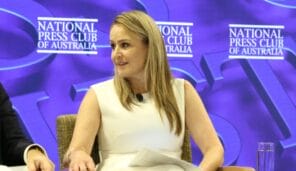

Deborah Fuhr’s message for financial planners about exchange-traded funds (ETFs) is simple: they are not the enemy. They may in fact be at the front-line of planners’ defences against the rise of the machines.
Fuhr says ETFs give to financial planners an ability to efficiently implement low-cost, diversified portfolios, freeing up time and thinking for a greater focus on the areas they really add value – including structuring, strategic advice, and behavioural coaching – where robo advisers cannot compete.
“ETFs have been embraced as a useful tool to help investors do their job,” says Fuhr, the founder of ETFGI, a London-based firm that specialises in tracking, monitoring, analysing and reporting on the development and growth of the global ETF industry.
“They’re not the enemy. In the early days ETFs were embraced by traders, often because there wasn’t a way to gain exposure to sectors in the US. So you had the sector SPDRs, which broke the S&P500 into nine sectors; you can use them to go long and short, so they are like a future; and [they provide] easy access.”
Fuhr says regulatory reform of the financial planning industry has encouraged the uptake of ETFs as more adviser focus less on “selling the products they were told to sell”.
“Once they focus on providing financial advice and look at the whole of the market, ETFs become an attractive proposition,” she says.
“With that changes comes more awareness of the impact of fees on performance.”
The biggest challenge, however, is still “to get someone to try ETFs”, Fuhr says.
“Until they try them, they’ll say they know what they are,” she says.
“It’s like you could say, yeah, I know what sushi is; but until you go you don’t know how to use the chopsticks and the difference between sushi and sashimi and what you’re actually getting.
“Once you understand how they trade, how they settle and they do what they say they’re going to do, you’re more comfortable to go and use them for other types of exposures, hold them in larger size, and hold them for longer. The big challenge is getting people to try, that’s really the hurdle; and then it goes on from there.”
Significant uptake
Fuhr says there has been significant uptake of ETFs in the Us, particularly by registered investment advisers (RIAs), “who find that if they’re really providing advice on tax and what is you tolerance towards risk and what are you saving for, they then migrate towards looking at buying solutions”.
“That could be risk profiles; it could be target-date [funds]; it could be tactical asset allocation. And very often the building blocks are ETFs,” she says.
“RIAs who run strategies that use at least 50 per cent ETFs now account for about $US100 billion ($128.6 billion) of ETF assets, and they are growing quite significantly. It’s hard to do everything, so they are rationalising where do they add value? In doing asset allocation they’re more likely to get it right than [doing] individual security selection.”
Fuhr says the assets of ETFs are likely to break through the $US3 trillion barrier this year, and in so doing will overtake hedge funds in size. ETFGI data shows that ETF assets had reached $US2.93 trillion by the end of March.
The first ETF appeared 25 years ago, on March 9, 1990, in Canada. Today there are more than 5600 ETFs listed on exchanges around the world.
“Many people forget Canada was three years before the US,” Fuhr says.
“The US is good at marketing and advertising news about the US. But Canada was three years before.”
Fuhr says the uptake of ETFs has been impressive since then.
“Hedge funds are 66 years old, and hedge fund data you typically get quarterly, but at the end of the year hedge funds were only $US60 billion bigger than the ETF industry. So my view is that ETFs will soon break through $US3 trillion, and become bigger than the hedge fund industry.”
ETFGI is not itself an ETF provider; in that sense its perspective is “pure” – it is focused only on helping investors, institutions and financial planners make better, more informed decisions about ETFs as an investment structure.
Launched just more than three years ago, ETFGI is funded largely by selling subscriptions to its information services.
Next phase
Fuhr says the next expected phase in the development of ETFs will be “more products built using ETFs – more target-date strategies, risk profiles, and robo advisers”.
“These are online platforms that allow you to go there and get advice and build portfolios of ETFs and [they are] growing in many places, especially among people who like to use their iPhone or iPad, because you can go there and play with your tolerance for risk, what you’re saving for,” she says.
“These tools have become simple in one way, but sophisticated in another way.
“So we’re seeing 8 Securities in Hong Kong, we’re seeing these firms popping up in Europe. The strategies that use ETFs make it easy for people to do asset allocation across all markets and across asset classes, which historically would be difficult to do.
“With the advent of being able to … get more information, people have views on things. The ability to get news from around the world instantaneously has caused people to be able to have a broader view on where they want to invest, and to feel they have views and information that enables them to make that decision.”