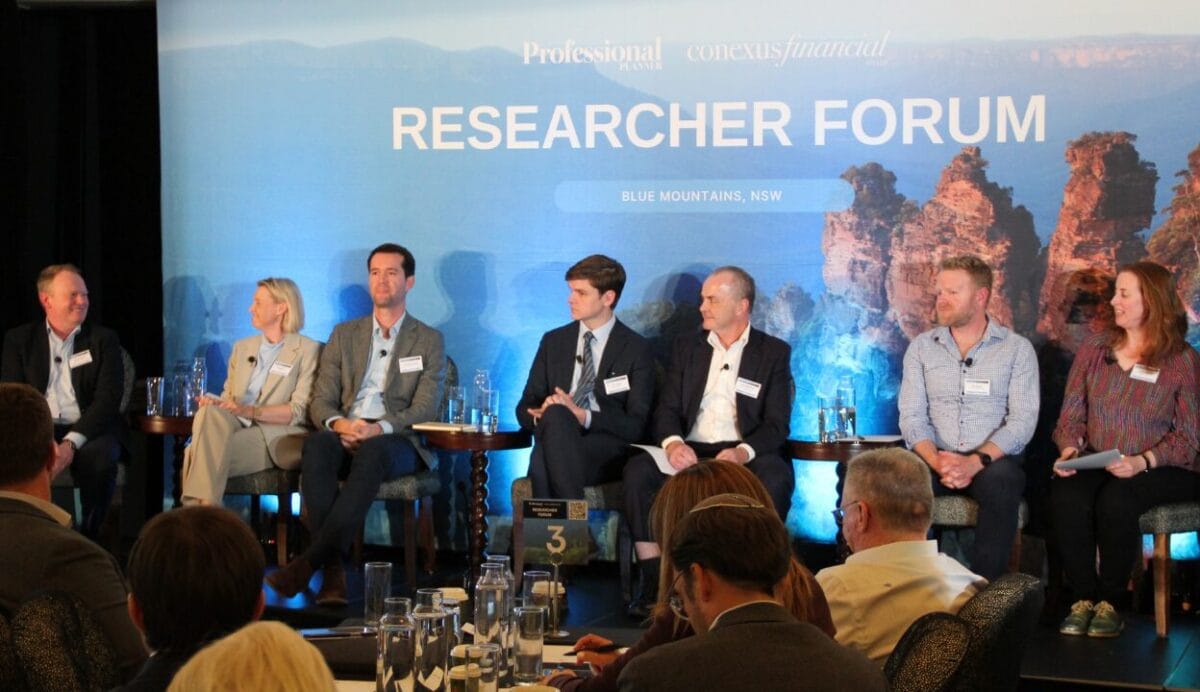

A balanced portfolio currently has 5 per cent sitting in cash which the client wants deployed to either equities or credit. That was the hypothetical scenario that advisers, researchers and asset consultants were presented with at the Professional Planner Researcher Forum.
Esteemed researchers including Genium co-chief executive Tim Murphy, Frontier Advisor principal consultant Claire Casucci and independent consultant, Brad Matthews, asked a panel of fund managers to put forward their best ideas, at the 2025 Researcher Forum.
During an interactive panel session portfolio managers from ClearBridge Investments, Royal London Asset Management, Orbis Investments and Schroders put forward the case for their respective asset classes.
According to ClearBridge Investments head of Australian equities Reece Birtles the “big, exciting story” in markets is the alpha opportunity in Australian value stocks relative to the broader equity market.
“This is one of the four big events of the last 25 years,” he said.
“Investors should move away from the index, away from high index stocks, and towards a defensive, value-orientated portfolio because the opportunity is large and the risks are relatively low.”
Birtles said the broader Australian equity market looked expensive and many current valuations could not be justified, however, a value portfolio actually had a price-to-earnings more in line with its historical average.
“The market often pays a premium for safety, for low beta companies, which we saw in 2015 and during Covid-19, but right now you can buy all the safer names cheaper than the rest of the market,” he said.
“When I talk about value, it’s mid-cap, it’s active, it’s fundamental. It’s away from momentum because the index has really been distorted by all the money flowing to passive strategies. As a result, some stocks are materially mispriced.”
Royal London Asset Management global equities fund manager Francois de Bruin highlighted that Australian value stocks did not give investors exposure to the mega themes of artificial intelligence (AI), data centres and power.
“AI equals [global] equities, and we can’t understate that factor,” he said, pointing out that while the Mag 8 [the traditional Mag 7 stocks plus Broadcom] represented over a quarter of the MSCI World Index, the benchmark’s exposure to AI could be as high as 45 per cent due to “factor convergence”, based on RLAM’s correlation analysis.
“When we think about new ideas in the context of what’s driving global equities and this AI boom it’s actually the corporates themselves,” de Bruin said.
“This isn’t information you’re going to get from governments or the Fed’s Beige Book, it’s the capital allocation decisions of companies and the technology that they are developing and using. Their roadmaps are dictating the future direction of equity markets and if you look at the S&P 500, certainly in the past nine months, they’re talking about power and how much energy they can push into the system to generate the computing power they need for AI.”
To illustrate the size and scale of the opportunity, de Bruin said that US corporates now talked in terms of gigawatts to quantify the amount of power they needed to operate.
Historically, this measurement was used primarily by cities and countries. For example, as a broad rule, a city of one million people needs one gigawatt of power to function.
Yet, AI safety and research company Anthropic claims that it will need eight gigawatts of power over the next five years, and OpenAI claims that it will require 11 gigawatts. In November, OpenAI also outlined plans to scale up its AI infrastructure to deploy 250 gigawatts of compute capacity by 2033.
To contextualise that, there are only ten cities in the US with a population of a million or more. Anthropic and OpenAI alone propose to use the same amount of power as the ten largest cities in the United States.
“The way we construct portfolios is informed by the concept of the corporate lifecycle, and that’s the context in which we are thinking about the power opportunity,” de Bruin said.
“Depending on where a company is in the corporate lifecycle, different factors matter. It’s also important to highlight that, through the corporate lifecycle, you move from growth-focused investing to quality-focused investing to value investing.”
At each stage of the lifecycle, RLAM has identified attractive companies including GE Vernova, Hubbell, Baker Hughes and Kinder Morgan.
Emerging opportunities
Equity markets, particularly the US, may currently look expensive but they’re not “equally expensive” in the context of the past 50 years, said Eric Marais, investment specialist and head of clients, Orbis Investments.
Emerging market equities look especially attractive, relative not only to the US but relative to historical valuations, he said, using the CAPE Ratio (cyclically adjusted price-to-earnings) to demonstrate his point.
“The US is around 38 times, using the CAPE Ratio, and emerging markets are in the ballpark of around 16 times,” Marais said, acknowledging that emerging markets had had a “horrid” decade and are coming off a low base.
“It’s no surprise that compounded returns from emerging markets have been way, way lower than developed markets, but you might be surprised that the volatility between emerging and developed markets hasn’t been much different over the past ten years,” he said.
This debunks the myth that emerging markets are inherently riskier.
Emerging markets can also potentially provide a volatility reduction benefit, although to capture that benefit investors would have needed a fairly significant exposure in the vicinity of 25 to 50 per cent in the past 10 years, Marais said.
“Emerging markets make a very meaningful contribution to the world’s population, GDP and market capitalisation, but they only represent around 10 per cent or so of the All Country World Index, which feels pretty darn low given how attractive emerging markets look right now and the potential risk reducing benefits at the portfolio level,” Marais said.
“At this point in the cycle, [investors] should be considering dedicated emerging market exposures since neither global indices nor active global funds are really capitalising on this opportunity in a meaningful way.”
Moving to the sexy stuff
Changing tact to talk about fixed income, Schroders fixed income fund manager Helen Mason said the macro-economic environment and investment regime that commenced in 2022 had experienced a stepped change into “fiscal dominance,” causing governments to allocate capital to tackle big issues like inequality of living, improving national security and defence, the energy transition and ageing demographics.
The result was gross debt to GDP of over 100 per cent and rising in developed countries, Mason said.
“In order for those debt levels to be sustainable, governments need to run their economies hot and maintain growth at elevated levels, which means higher levels of inflation, higher interest rates, higher real and nominal rates, and higher credit risk premiums,” she said.
“That’s good news for investors looking for income in their portfolios because we’re going to be in a higher for longer environment.”
The implication for those invested in broad multi-asset portfolios is that “genuine diversification” becomes even more critical because the growth component of portfolios is “very vulnerable” to changes to the economic cycle given the stretched valuations and also the correlation between growth and defensive assets, namely government bonds, “have turned positive or, at best, unstable,” Mason said.
“Traditional defensive assets are not providing the diversification that you previously got so you need to think about other opportunities for diversification like high-yielding Australian credit, emerging market debt, and hedging your equity risk with some commodities and currency.”
Mason observed that prior to the Covid-19 pandemic, the best source of income was Australian franked dividend yields, however, that had changed with Australian investment grade credit now representing the best source of income.
“That’s giving you 3.1 per cent over global equities and 80 basis points over Australian franked dividends, and 1.2 per cent over cash,” she said, adding that the Australian credit universe was one of the highest quality markets in the world due to the country’s highly regulated banking system and an index dominated by strong corporates and regulated assets.
“It’s really stable, transparent and liquid, with low volatility cashflows dominated by infrastructure, utilities and other monopolies or duopolies,” Mason said.
“These businesses are the backbone of this country, servicing our economy and communities, and they provide great diversification too because 60 per cent of the Australian credit index is not listed on the equity market.”
Delegates in the room were asked before the workshop where they would allocate 5 per cent in cash with 45 per cent of the room believing emerging markets was the best option and 33 per cent preferring AI-powered global equities.
But after hearing the cases from all four asset managers, support for emerging markets dropped to 38 per cent (still leading the room), but Australian credit doubled its support with 31 per cent now believing this was the best choice for the allocation.