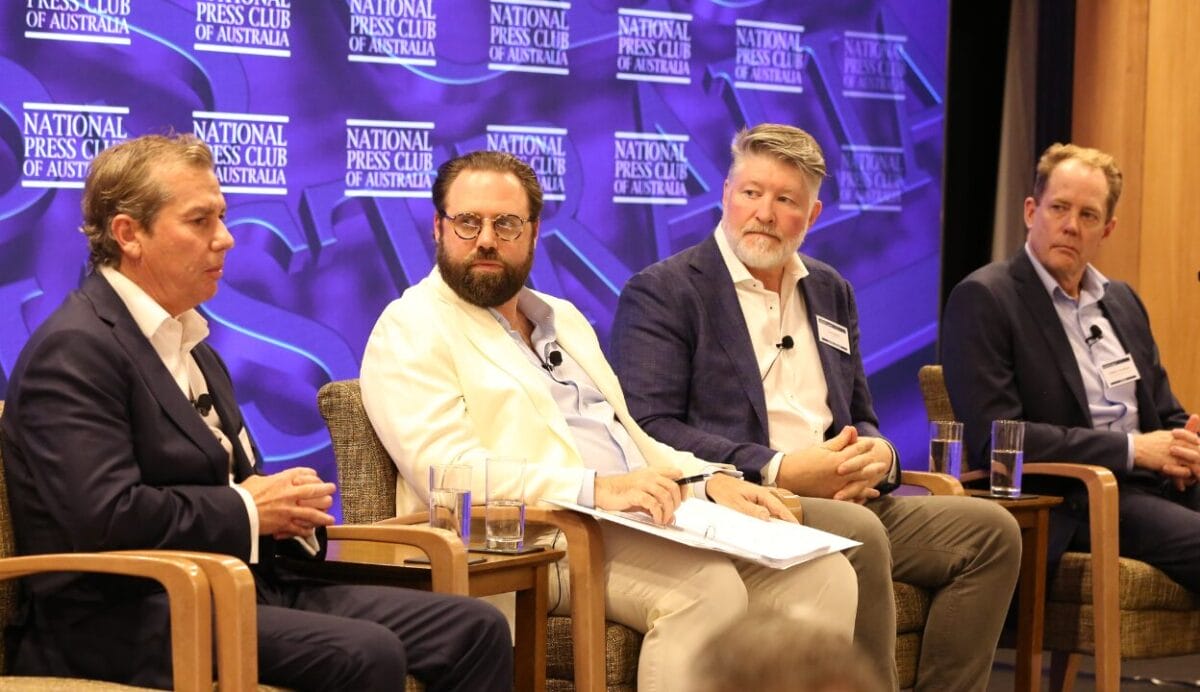

When it comes to advice tech, licensees must offer “freedom within a framework” that balances choice, the Professional Planner Advice Policy Summit heard.
HUB24 strategic development director Jason Entwistle said the industry is moving away from “tech stacks” – where different software applications are added into a process but don’t necessarily communicate with each other – to an ecosystem where there is a common infrastructure.
“Apple delivers a whole lot of technology and apps that live in that environment and leverages that infrastructure,” Entwistle said.
“If we can get to that point where there’s a common infrastructure, common ways we share data… we can create a really thriving environment of fintechs. Choice of technology is important, but it’s got to be freedom within a framework.”
Matt Lawler, CEO of Entireti-owned Akumin, said the biggest “fear” from advisers when discussing tech stacks is that the licensee will mandate a single system to use.
“We’re not that shop, we’re going to provide choice right along the chain in terms of what applications,” Lawler said.
“Now we won’t have thousands [of options] but we’re likely to have three or four choices along every part of the process for them to choose.
“Things like digital signatures, you probably won’t need four choices… but in modelling you might have to have four or five because some models specialise in retirement, some specialise in accumulation.”
Nathan Jacobsen, who was recently appointed chief operating officer at AZ Next Generation Advisory, said the firm would move to a preferred tech stack for cybersecurity and efficiency reasons.
“One of the core principles, which is clear from ASIC on what their views are on this as well, is we’ve all got to move from this world of policies and trust to real-time assurance which is a very different situation,” Jacobsen said.
“We’re migrating every one of our firms into a single tenancy. We’re moving all of them to one IT support company which we’ll run ourselves and we’re overlaying all the cyber monitoring and real time security operations, including constant monitoring of tax file numbers.”
Managed account gains
Entwistle said when it comes to innovation and productivity – which creates capacity and supply – managed accounts can’t be overlooked.
“The managed accounts capability that is now prevalent across pretty much all the mainstream platforms is the biggest productivity gain we’ve had in the industry for probably the last two decades,” Entwistle said.
“AI will trump it, but it’s been really good for advisers in their practices. It might be that advice fees would be even more expensive if we didn’t have this capability being adopted so widely.”
Entwistle said there are client benefits as well, pointing to a report it commissioned Milliman to conduct, which found that delaying the implementation an adviser’s instruction has a negative impact on a client’s outcome.
“If you’re a practice of 100 or 120 clients and the adviser makes the call that we’re going to get out of a particular fund or stock, it takes them time to implement that,” Entwistle said.
But a criticism of managed accounts is a perceived lack of transparency, which Entwistle dismissed.
“You can absolutely see through them and all the platforms publish their performance data, we do it a client level, generally,” Entwistle said. “It’s completely transparent and I’m not sure what the dark corner is.”
Entwistle said the advice landscape becomes totally different if 15,000 advisers are left to make their own investment decisions.
“With the managed account, it’s a much more consistent outcome. There’s a professional portfolio manager in the mix and an RE [responsible entity] sitting on top,” Entwistle said.
“ASIC would’ve told us if this wasn’t true, there were no First Guardian or Shield holdings inside a managed account because the portfolios manager and the RE didn’t allow them in.”
Greater transparency for the new gatekeepers
Jacobsen said managed accounts have their benefits, but greater transparency is needed.
“Managed accounts came from a positive reason, which was advisers were sitting there choosing their own model portfolios based on the BDM that turned up to their door,” Jacobsen said.
“Managed accounts have got them focused on goals, working with professional investment advisers, forcing administration and fee [costs]. It’s a net positive, but I don’t agree that it’s currently a transparent market.”
Jacobsen said greater transparency has become a focus for AZ NGA.
“The largest provider in the market is $25 billion, the vast majority are $3 billion to $4 billion and they’ve got maybe five staff,” Jacobsen said.
“They are the new gatekeepers in the industry. We don’t know what their performance is, it’s not actually easy to see because every portfolio on every platform has got different numbers. I know this because I ran a licensee and I tried to work it out. I can’t get ratings on them. SQM was the only one.”
Entwistle disagreed on the transparency, arguing that by design, every platform managed account will have different numbers because the performance on a managed account is the combination of the model or “the recipe “of the manager and the implementation on the platform.
Lawler said that from the client benefit perspective, every SMA that a practice puts forward must come via an asset consultant and be approved by their investment committee.
He added that there is significant negotiating power for larger licensees or advice networks with significant assets under management which can lead to lower fees from the managers.
“When the adviser makes a recommendation to the client, it has to be in their best interest,” Lawler said.
“A key component of it being in the client’s best interest is the price. You have to prove it is cheaper than what they were in before.”